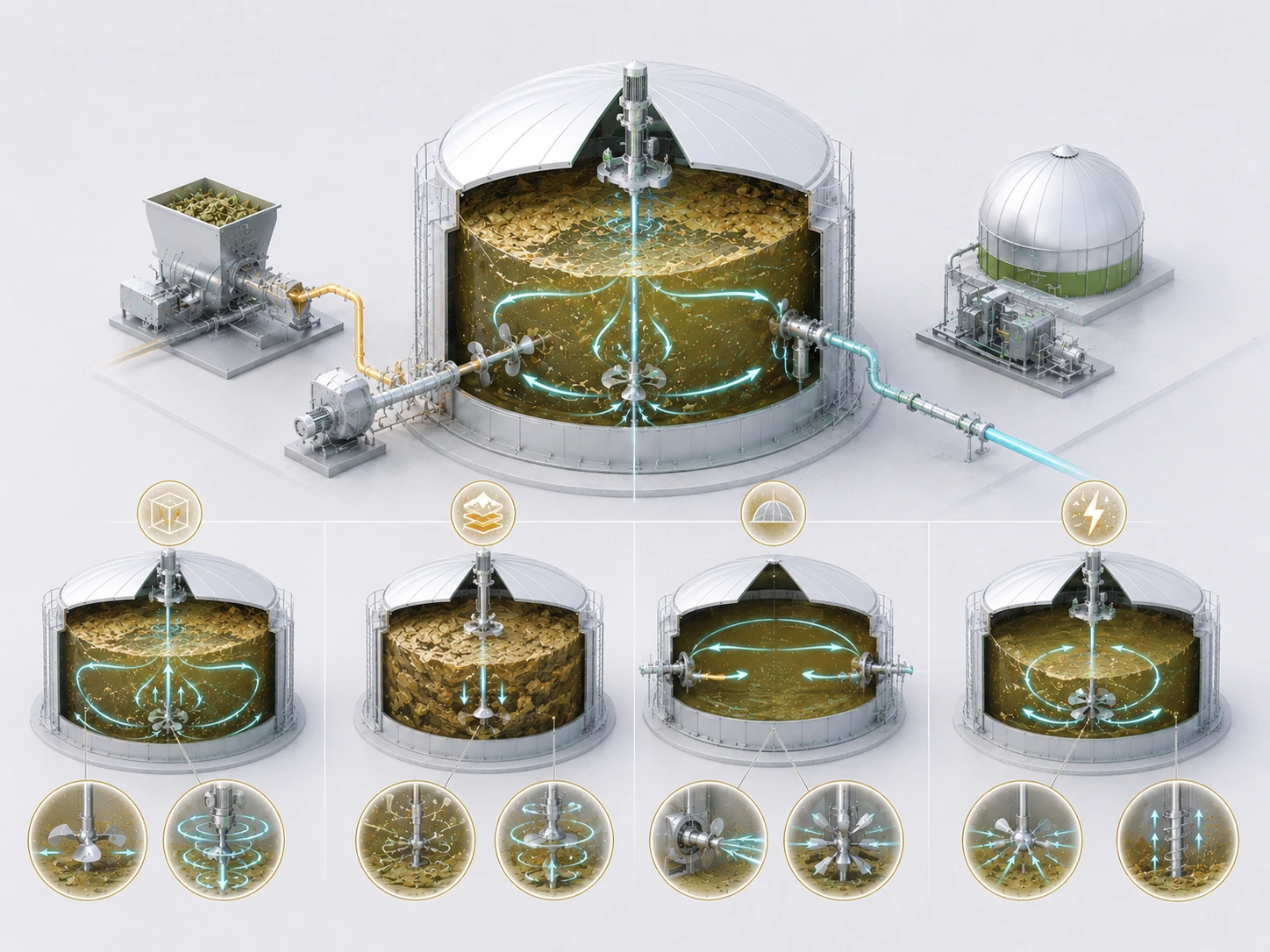
A common mistake when choosing a mixer is to start with a catalogue and ask how many kilowatts are needed. First describe the tank and substrate, then define the required flow pattern; only then select the equipment type, position, number and power rating.
1. Tank geometry
The diameter, height, operating fill level, floor shape and position of the roof and gas membrane all matter. A wide, shallow tank needs a different flow pattern from a tall digester with roughly equal diameter and height. SUMA associates its central mixers with very large tanks where strong vertical circulation can develop.
2. Substrate and dry matter
The dry matter percentage alone is insufficient. Two mixtures with the same dry matter content can behave very differently if one contains fine particles and the other long grass or straw fibres. Viscosity, fibre content, abrasiveness, settling tendency and surface crust formation all matter.
3. Where does fresh substrate enter?
The mixing system should pick up newly introduced material and distribute it through the active biomass. The feeding inlet, recirculated liquid, outlet to the secondary digester and heating system should therefore be considered together with mixer placement.
4. One large mixer or several smaller ones?
A single central, slow-speed system can be effective in the right tank geometry, while several side-entry or submersible mixers offer more options for directing flow and provide redundancy. Systems are often combined: for example, a large slow-speed agitator for general circulation and an additional side-entry mixer for a critical area.
5. Maintenance and access
The difficult question needs an answer in advance: what happens if a mixer stops? Can the motor be replaced from outside? Can a submersible mixer be removed without emptying the tank? Must the gas membrane be opened? Landia GasMix and side-entry systems emphasise external maintenance access; suppliers of central and long-shaft mixers have their own maintenance arrangements.
6. Annual energy consumption
Motor nameplate power is not annual energy consumption. Operating hours, variable-speed drive capability, intermittent or continuous operation and actual hydraulic efficiency all affect consumption. A large slow-speed propeller can have a very different consumption profile from several smaller, faster mixers.
7. Request a mixing concept, not just an equipment quotation
Ask the manufacturer or designer to show mixer positions in plan and section, expected flow directions, selection criteria and performance at minimum and maximum fill levels. CFD simulation can help compare options for complex tanks, but it must use realistic substrate properties.
Manufacturers to consider in a comparison
SUMA covers submersible, long-shaft, central and paddle mixers. streisal offers submersible TSR/TSRL mixers as well as Biobull and Biosubstrator. Landia allows comparison of submersible and side-entry mixers with the external GasMix concept. Sulzer has large Scaba top-mounted agitators, while EKATO is relevant for specialised propellers for fibrous media.
Sources and further reading
- SUMA – Biogas agitators and selection criteria
- streisal – Applications and selection of agitator technology
- Landia – GasMix digester mixing system
- Sulzer – Scaba top-mounted agitator
- EKATO – AQUAJET-B
This information is provided for guidance. Final mixer selection requires data on tank geometry, actual substrate properties, process operation and safety requirements, as well as confirmation from the equipment manufacturer. The illustration shows a functional principle, not a detailed engineering design.