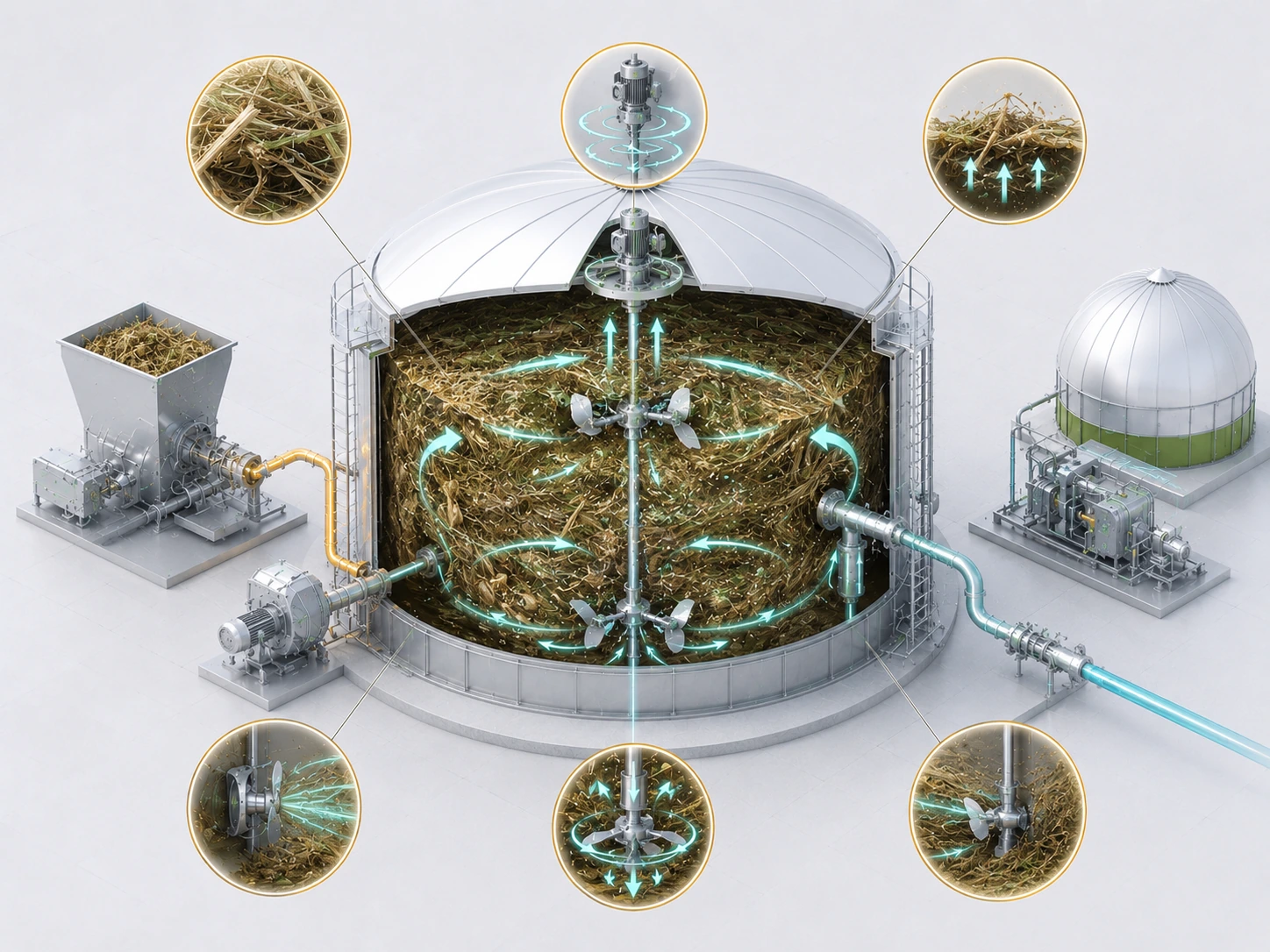
A digester processing slurry presents a different hydraulic challenge from one receiving grass silage, straw or a high proportion of solid manure. Long fibres increase apparent viscosity, can wrap around shafts and blades, and may intertwine to form a floating layer that is hard to draw back into the bulk material.
Common problems
- fibres wrapping around the shaft and propeller,
- increased torque and motor current,
- formation of a dense floating crust,
- local settling of heavy particles,
- uneven distribution of fresh feedstock,
- reduced propeller performance as material accumulates on it.
Propeller geometry matters
EKATO AQUAJET-B was developed specifically for media containing long fibres. The manufacturer uses a large hub diameter and backward-curved leading edges so that fibres slide along the blade instead of wrapping around the shaft. For demanding substrates, propeller shape can matter as much as motor power.
Large propeller, lower speed
streisal Biosubstrator and Biobull and SUMA's central and long-shaft designs take another approach: large diameter, lower speed and high circulation flow. streisal specifically lists Biosubstrator for fibrous components and high dry matter content, while an enlarged hub also reduces the risk of material wrapping around the shaft.
Substrate preparation still matters
Even the best mixer cannot fully compensate for inadequate substrate preparation. If long straw or grass enters in large clumps, the mixer is being asked to solve a problem created at the feed system. Size reduction, mixing with a liquid fraction and controlled digester feeding can significantly reduce mixer load.
Manufacturer examples
EKATO AQUAJET-B is an example of geometry designed for long fibres. streisal Biosubstrator, Biobull and TSRL Hybrid offer different approaches to difficult biogas substrates. SUMA can combine long-shaft, submersible and paddle mixers for more demanding processes.
Sources and further reading
- EKATO – AQUAJET-B for long fibrous components
- streisal – Biosubstrator
- streisal – TSRL Hybrid
- SUMA – Biogas agitators
This information is provided for guidance. Final mixer selection requires data on tank geometry, actual substrate properties, process operation and safety requirements, as well as confirmation from the equipment manufacturer. The illustration shows a functional principle, not a detailed engineering design.