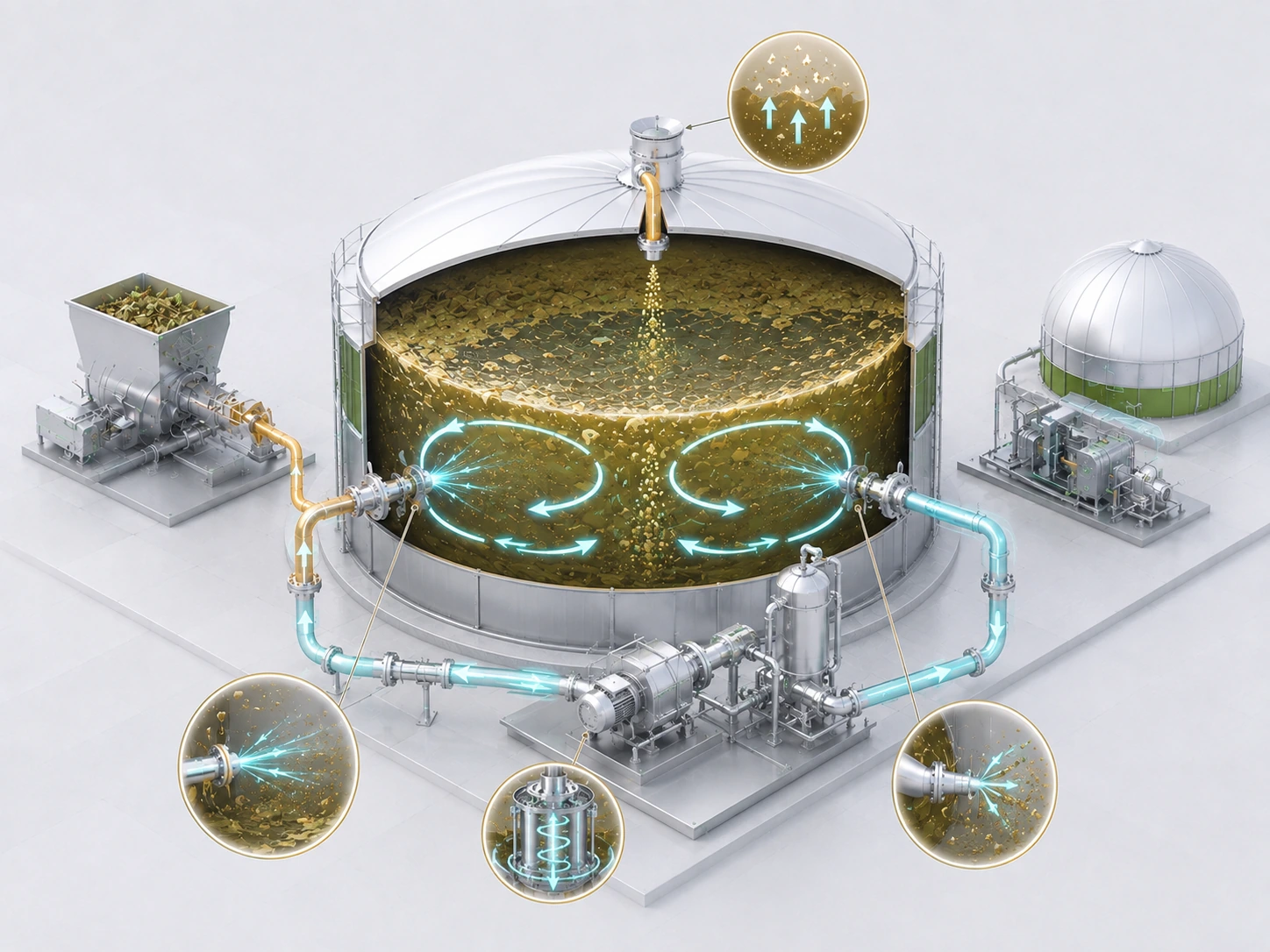
Not every digester is mixed by a conventional propeller with a motor in the tank. One alternative draws biomass out of the digester, passes it through an external pump and returns it through suitably positioned nozzles. Systems that also recirculate biogas use the jets to generate intensive circulation in the tank.
Why place mechanical equipment outside?
Maintenance is the principal argument. Landia GasMix places all mechanical components outside the digester. According to the manufacturer, the system can be serviced without opening or emptying the tank, so the biological process can continue during most maintenance work.
GasMix recirculates liquid biomass and biogas to mix the tank contents. Landia lists applications across different tank types, approximately up to 10,000 m³ and around 14% dry matter, depending on actual process conditions.
How is flow created?
A pump draws biomass from the tank and returns it under pressure through nozzles at selected levels. The resulting directed flow moves the contents without a conventional immersed drive unit. In the GasMix concept, recirculated biogas is also introduced into the flow.
Advantages and limitations
- Advantage: maintenance of the pump and other mechanical parts at ground level.
- Advantage: no submersible motor or conventional propeller that must be retrieved from the digester.
- Advantage: potential suitability for retrofitting existing tanks.
- Limitation: the pump and nozzles must be sized for the actual fibre and solids content.
- Limitation: nozzle positions are critical to reaching the full tank volume.
Manufacturer example
Landia GasMix is a clear commercial example of the concept for biogas plants. Landia also offers side-entry and submersible mixers, allowing different approaches to be compared within a project. For retrofits, its JetMix arrangement with an external pump and multi-level nozzles may also be relevant.
Sources and further reading
This information is provided for guidance. Final mixer selection requires data on tank geometry, actual substrate properties, process operation and safety requirements, as well as confirmation from the equipment manufacturer. The illustration shows a functional principle, not a detailed engineering design.