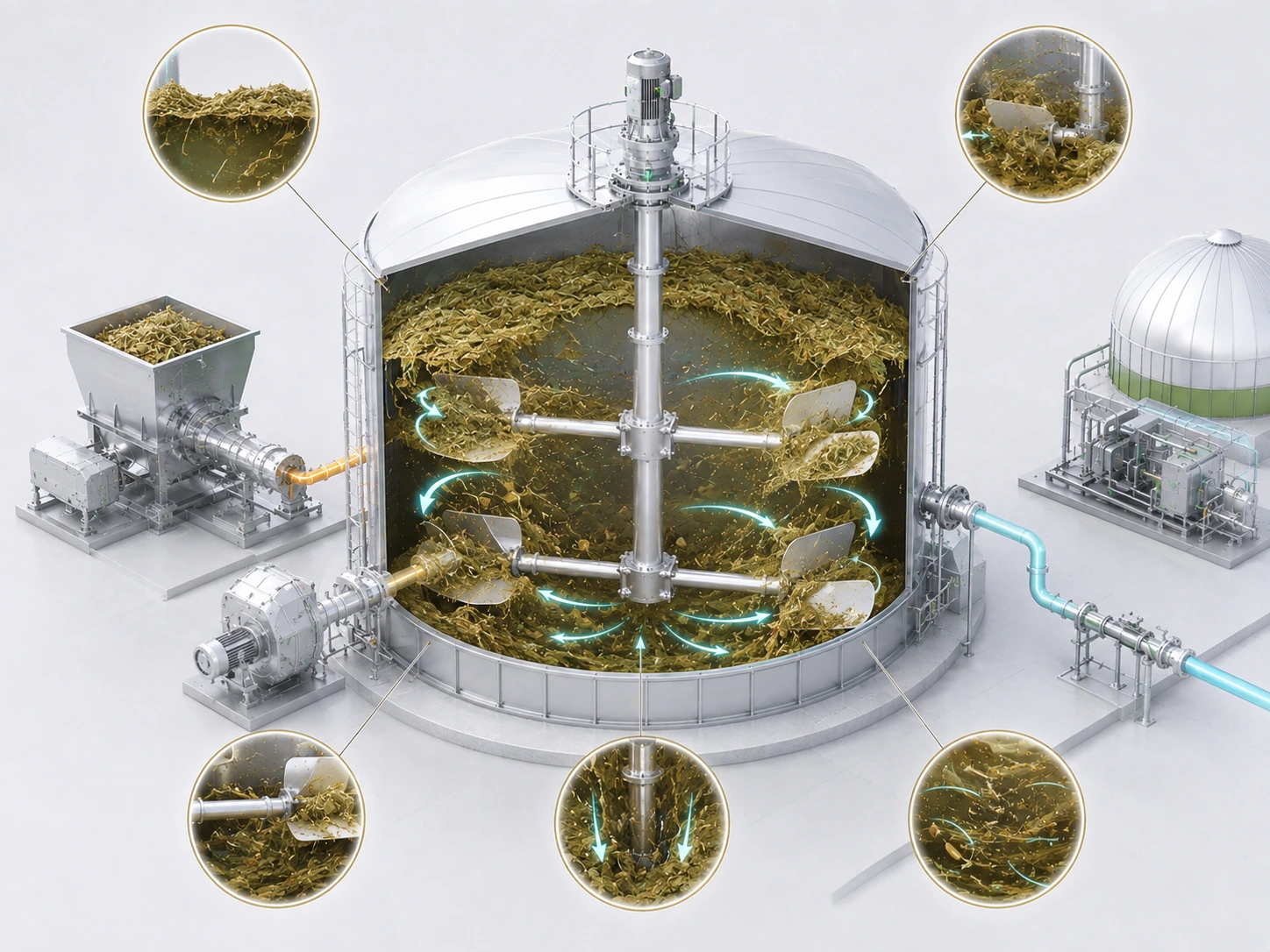
A paddle mixer is more than an oversized propeller. Wider mixing elements engage a large volume of viscous material at low speed instead of producing flow with a few narrow propeller blades. This makes it relevant for digesters with persistent floating layers, sedimentation or very thick biomass.
How do they differ from propeller systems?
A propeller produces a directed jet and strong axial flow. A paddle system instead slowly moves and turns material across a large part of the tank. This can help where a surface crust forms or a layer needs to be broken up that does not behave like a conventional liquid.
In 2025, SUMA expanded its range to include paddle mixers, which it identifies for viscous media and floating or sedimented layers. Horizontal and vertical versions are available; part of the range stems from its collaboration with Steverding Rührwerkstechnik.
Combining them with other mixers
A paddle mixer is often not the only device in a demanding digester. Large slow-moving paddles can keep the bulk material moving, while a side-entry or submersible mixer directs additional flow towards the fresh-substrate inlet or another specific zone. Manufacturers increasingly offer a complete mixing concept rather than one universal machine.
What requires attention?
- torque on the shaft and gearbox when starting in thick material,
- ability to restart after a prolonged shutdown,
- contact between paddles and fibrous or abrasive material,
- bearings and supports inside the tank,
- maintenance access and protection of the gas membrane,
- the effect of fill level on actual performance.
Manufacturer examples
SUMA now includes paddle agitators in its biogas range, including its own and Steverding designs. Steverding Rührwerkstechnik specialises in this equipment and, through its cooperation with SUMA, contributes to projects combining several mixer types.
Sources and further reading
This information is provided for guidance. Final mixer selection requires data on tank geometry, actual substrate properties, process operation and safety requirements, as well as confirmation from the equipment manufacturer. The illustration shows a functional principle, not a detailed engineering design.