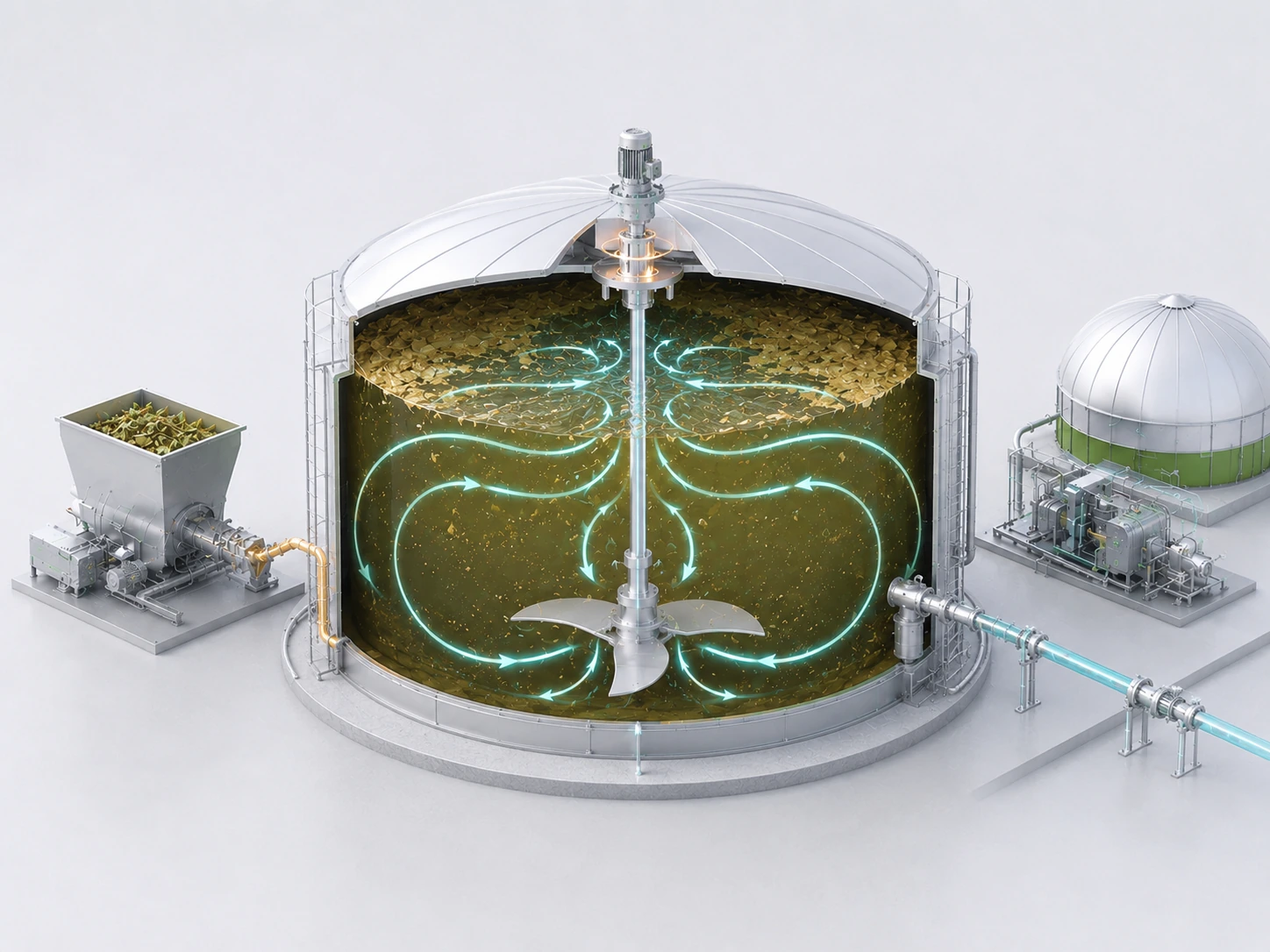
A central mixer works differently from a small, high-speed propeller. Instead of a strong local jet, it uses large mixing elements at low rotational speed to move a large volume of biomass across the digester section.
Vertical circulation
In a typical central arrangement, the mixer enters through the centre of the roof. A paddle or propeller moves material along the shaft in one direction, with return flow near the walls. SUMA identifies this concept as particularly suitable for very large tanks whose diameter and height are broadly comparable.
In a SUMA project, a Z-MIX operates in a 9,950 m³ tank, with three mixing levels 5.8 m in diameter at only 11 rpm. Sulzer used 4.5 m Scaba mixers running at 8 rpm with 11 kW motors in large digesters in Vienna. Both illustrate the principle: a large effective mixing area and slow, continuous movement.
Advantages of a slow-speed arrangement
- high circulation at lower rotational speed,
- less localised shearing of the substrate,
- ability to move a very large volume,
- potentially good energy efficiency where tank geometry suits the concept,
- drive and service components can be accessible from the roof.
Limitations
Central mixing is not universally applicable. It needs a suitable roof structure, enough room for the shaft and lifting equipment, and tank geometry that permits full vertical circulation. A side-entry horizontal flow pattern may be more appropriate for a very shallow, wide tank.
Manufacturer examples
SUMA Z-MIX uses several levels of large paddles in very large tanks. streisal Biobull / Vertical Biobull uses large, slow-speed propellers and specifies circulation flow rates of up to 22,600 m³/h for certain versions. Sulzer Scaba is an example of a large top-mounted agitator used in anaerobic digestion and sludge treatment.
Sources and further reading
- SUMA – Maximum efficiency for large biogas plants / Z-MIX
- streisal – Vertical Biobull BIOS
- Sulzer – Vienna digester mixing with Scaba agitators
This information is provided for guidance. Final mixer selection requires data on tank geometry, actual substrate properties, process operation and safety requirements, as well as confirmation from the equipment manufacturer. The illustration shows a functional principle, not a detailed engineering design.