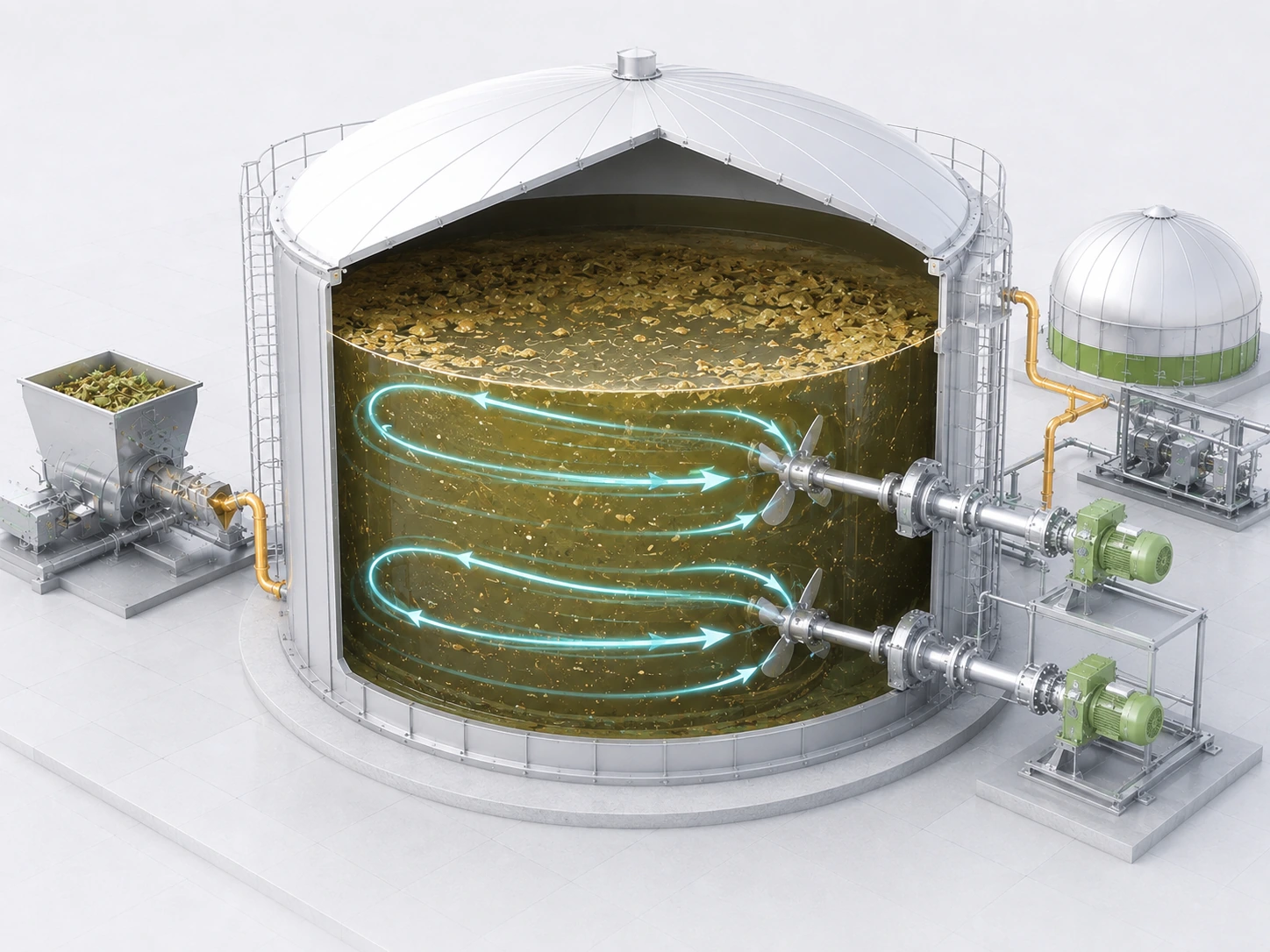
A long-shaft or side-entry mixer has a practical advantage: the main drive and service components can remain outside the digester while the shaft and propeller enter through its wall or roof. This produces a strong directed flow and makes maintenance easier than for a fully submerged drive unit.
How do they work?
The propeller produces predominantly horizontal flow through the tank. In large-diameter tanks, one or more mixers are often set at different angles to address dead zones and establish circular flow. SUMA identifies its long-shaft GIANTMIX models for large tanks, horizontal circulation and both thick and more fluid substrates.
streisal Biosubstrator uses a large, slower-running propeller with adjustable height. The manufacturer also positions it for abrasive, fibrous and drier substrates. Landia POPTR-I is a more compact side-entry design whose motor remains dry and accessible from outside.
When are they particularly relevant?
- large digesters with a relatively stable fill level,
- tanks requiring strong flow from one side to the other,
- projects where external maintenance access is important,
- more viscous substrates for which a small fast propeller is unsuitable,
- retrofitting existing tanks where a submerged motor is best avoided.
Installation matters as much as the equipment
Shaft angle, propeller clearance from the wall and floor, fresh-substrate inlet position and orientation relative to other mixers determine whether the energy produces useful circulation. Several side-entry mixers should ideally support the same overall flow pattern rather than create competing vortices.
Maintenance and sealing
An external motor does not make the system maintenance-free. The penetration through the digester wall must be gas-tight and structurally sound; the shaft, bearings and seals must withstand vibration and a corrosive atmosphere. Selection should establish which parts can be serviced externally and what is involved in removing the propeller or shaft.
Manufacturer examples
SUMA GIANTMIX and REKORDMIX cover different shaft lengths, power ratings and propeller diameters. streisal Biosubstrator uses lower rotational speed and a large propeller, with an emphasis on high circulation and external access to service parts. Landia POPTR-I is a dry-mounted side-entry mixer whose motor can be serviced without emptying the tank.
Sources and further reading
This information is provided for guidance. Final mixer selection requires data on tank geometry, actual substrate properties, process operation and safety requirements, as well as confirmation from the equipment manufacturer. The illustration shows a functional principle, not a detailed engineering design.