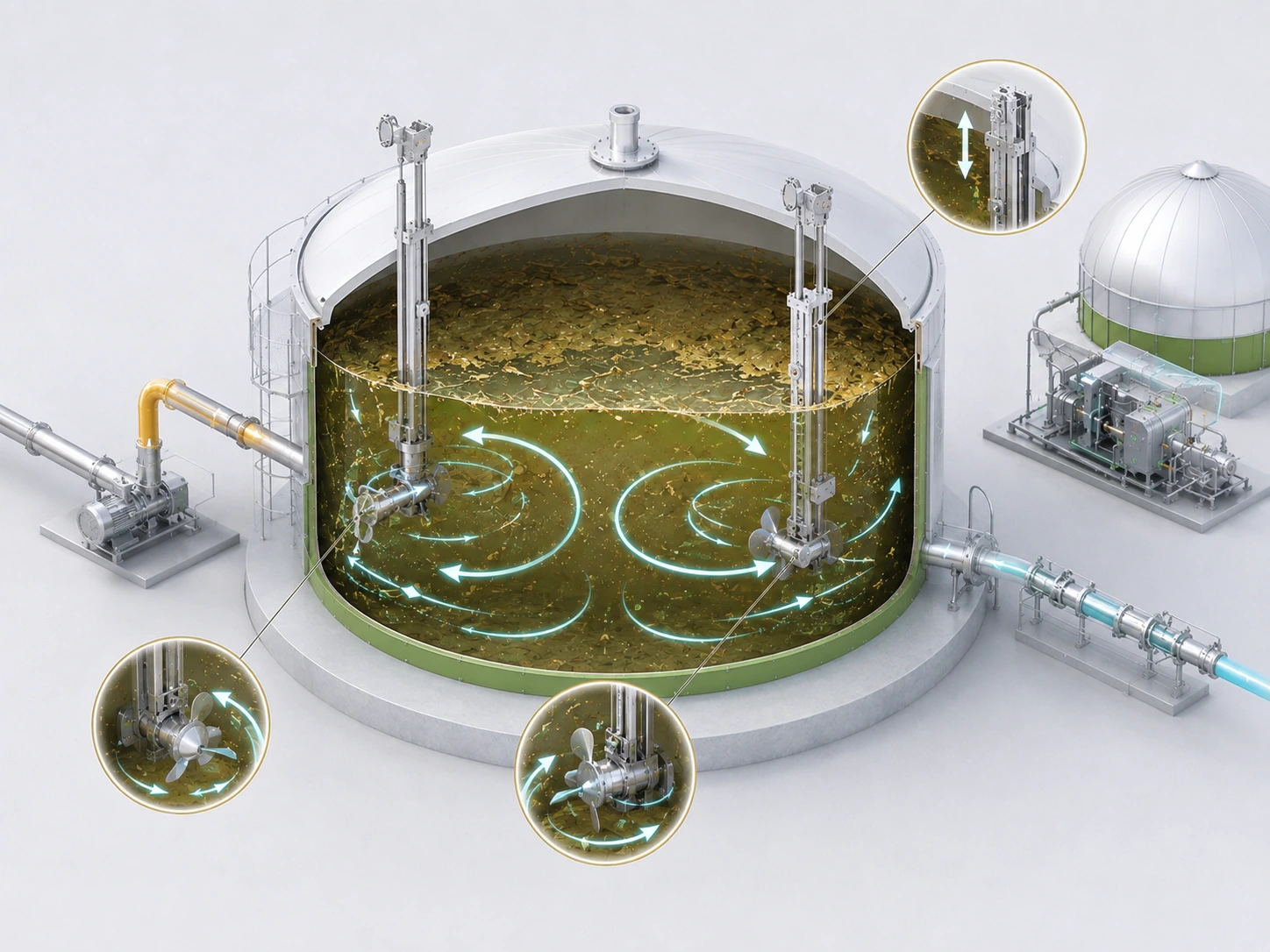
In a submersible mixer, the electric motor, drive and propeller form a single assembly immersed in the substrate. In biogas tanks, these mixers are often mounted on a vertical guide rail so that their height and, depending on the mounting, direction can be adjusted to actual digester conditions.
What is the main advantage?
Flexibility is the main benefit. When fill levels vary, the mixer can be positioned so that the propeller remains properly submerged. Where sediment or a floating layer forms in one part of the tank, its position and direction can be adjusted to strengthen flow there.
SUMA lists OPTIMIX applications in primary and secondary digesters, final storage tanks and receiving pits. The streisal TSRL Hybrid was developed for biogas tanks with relatively high dry matter content and uses large, hydraulically optimised propellers at lower speeds.
When does a submersible mixer make sense?
- for tanks whose diameter is much greater than their height,
- when fill levels vary,
- when operating height or angle needs to be adjustable,
- as an additional mixer alongside another main system,
- in secondary digesters and digestate tanks with varying process conditions.
What requires attention?
The main practical difference from a dry-mounted mixer is maintenance. The motor and seals operate in an aggressive medium, making enclosure quality, motor protection, seal monitoring and safe retrieval essential. Before purchase, establish whether the mixer can be removed without emptying the tank and how the guide rail and hoist are accessed.
Placement is equally important. A good mixer in the wrong position may simply circulate material locally. With several units, their flows should not cancel one another or create short circulation paths without vertical exchange of material.
Manufacturer examples
SUMA OPTIMIX comes in several sizes and power ratings for different tanks. streisal TSR/TSRL Hybrid is intended for both conventional and more viscous biogas media; the manufacturer lists propeller diameters up to 1,290 mm for TSRL and use with relatively high dry matter content. Landia also offers submersible mixers, which can be compared with its externally mounted GasMix and side-entry arrangements.
Sources and further reading
- SUMA – Submersible mixers for biogas
- streisal – TSRL Hybrid submersible agitator
- streisal – Submersible agitators overview
This information is provided for guidance. Final mixer selection requires data on tank geometry, actual substrate properties, process operation and safety requirements, as well as confirmation from the equipment manufacturer. The illustration shows a functional principle, not a detailed engineering design.