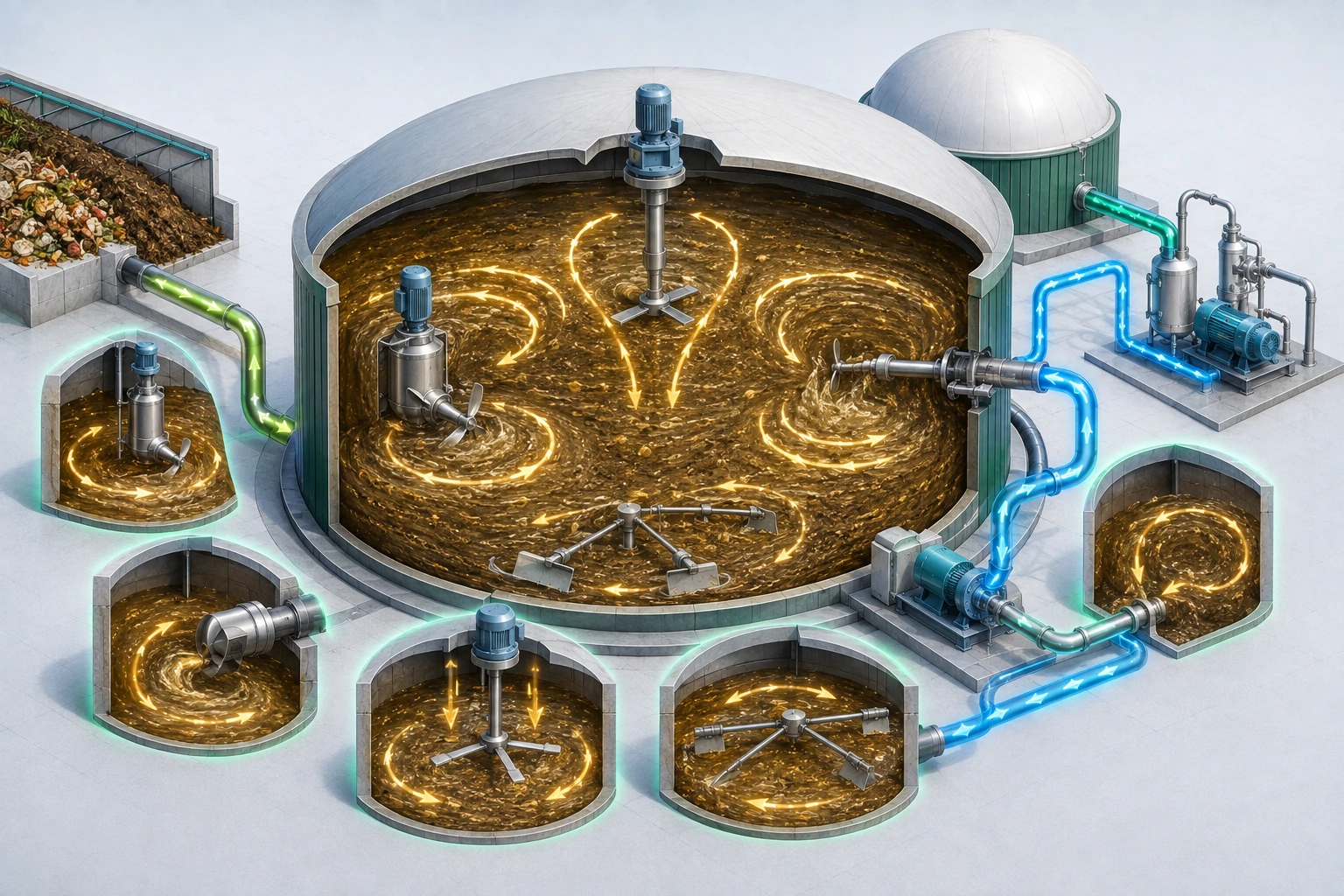
A digester mixer does more than move the contents around. It must create sufficiently controlled flow to distribute fresh substrate throughout the actively digesting biomass, keep temperatures as uniform as possible and prevent zones where material settles or floats without adequate contact with microorganisms.
What should effective mixing achieve?
In operation, the four main aims are to homogenise the tank contents, distribute heat, keep solids moving and break up floating layers. For anaerobic digestion, Sulzer specifically identifies temperature equalisation, biomass homogenisation, prevention of sedimentation and breakup of surface crusts. These describe what an operator needs from a mixing system.
More vigorous mixing is not necessarily better. Higher speed increases the system's electricity consumption, hydraulic loading and wear. The aim is therefore adequate flow throughout the digester's usable volume, rather than maximum turbulence.
Why is there no universal mixer?
Tank geometry, digester diameter and height, fill level, dry matter content, fibre length, the fresh-substrate inlet and outlet position strongly influence technology selection. SUMA therefore groups its biogas range into submersible, long-shaft, central and paddle mixers, while streisal notes that different tanks and substrates often call for different types or combinations.
At one plant, a side-entry mixer might create horizontal flow while a slow-speed central mixer provides vertical circulation. At another, several submersible mixers at different heights may perform better. At a third, keeping all mechanical components outside the tank may be the priority.
Main technologies in use
- Submersible mixers – the motor and propeller are immersed in the substrate; their height and orientation can be adjusted.
- Long-shaft and side-entry mixers – the drive is accessible from outside, while the shaft and propeller enter through the tank wall or roof.
- Central slow-speed mixers – a large propeller or several levels of paddles move a large volume at low rotational speed.
- Paddle mixers – large paddles are suited to viscous mixtures and to breaking up floating and settled layers.
- External recirculation – a pump, nozzles and recirculation of biomass or biogas create flow without a conventional immersed drive unit.
What should the operator monitor?
Mixing problems often appear in the process before they become apparent at the mixer: temperature differences between tank zones increase, a floating layer forms, sediment accumulates, fresh substrate remains concentrated locally or electricity use rises without an observable improvement in circulation. The response should be to assess the entire hydraulic concept, not simply install a larger motor.
Examples of manufacturers and solutions
SUMA offers submersible OPTIMIX, long-shaft GIANTMIX/REKORDMIX, central Z-MIX and paddle systems. streisal combines submersible TSR/TSRL mixers with Biobull and Biosubstrator systems. Landia offers GasMix with external recirculation alongside conventional mixers. Sulzer uses large, vertically mounted Scaba agitator systems for anaerobic digesters.
Sources and further reading
- SUMA – Biogas agitators
- streisal – Applications and biogas agitator selection
- Sulzer – Scaba top-mounted agitator / anaerobic digestion
This information is provided for guidance. Final mixer selection requires data on tank geometry, actual substrate properties, process operation and safety requirements, as well as confirmation from the equipment manufacturer. The illustration shows a functional principle, not a detailed engineering design.