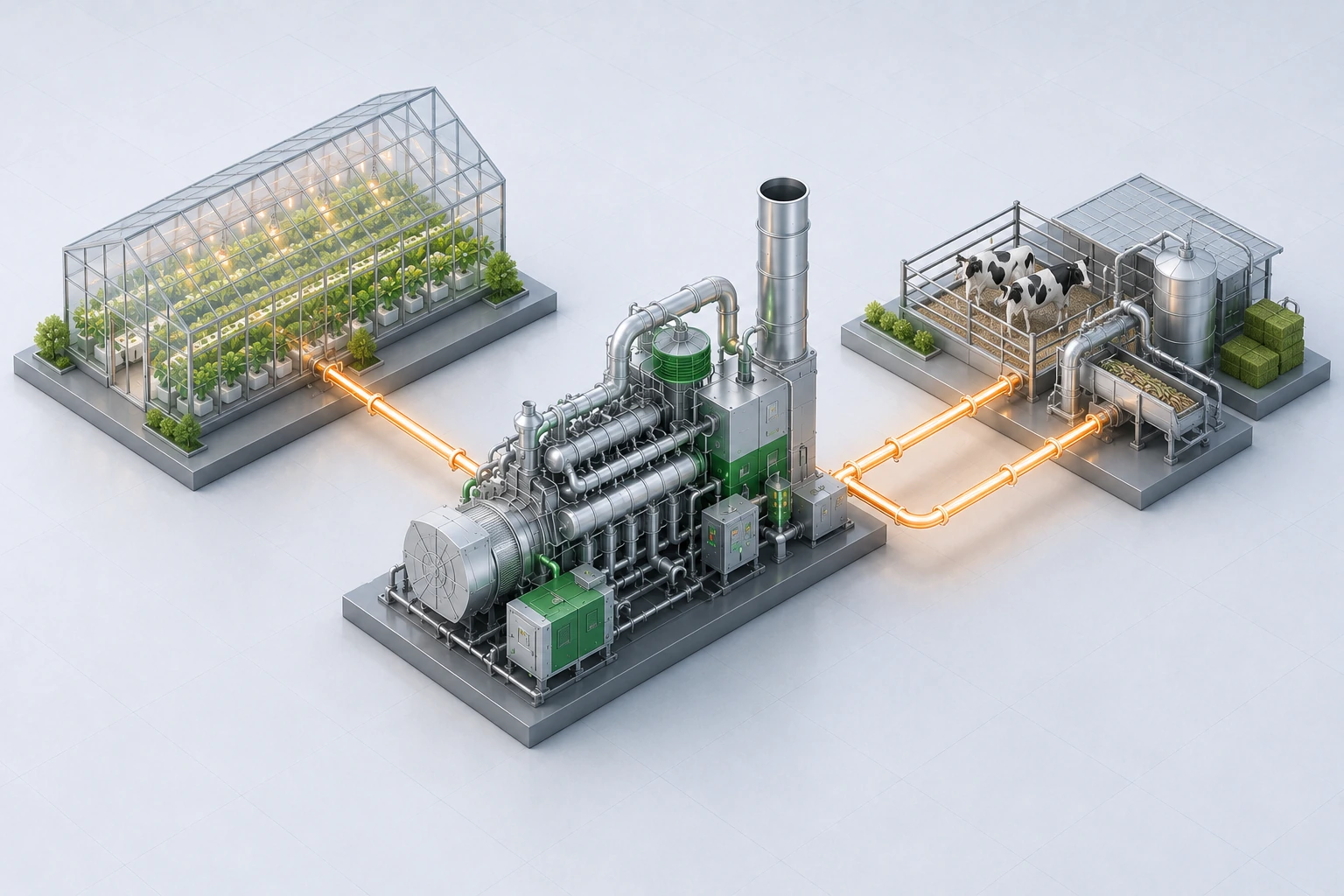
The advantage of an agricultural site is that several users are often close together. Heat can serve the digester, greenhouse, poultry house, workshop, hot-water system and dryer, each with a different daily and seasonal demand profile.
A greenhouse is a large but seasonal heat user
Greenhouse heating can absorb substantial capacity, particularly on cold nights and in winter. Sizing considers the outdoor design temperature, greenhouse area and construction, desired indoor temperature and storage capacity. A large thermal store can decouple CHP operation from immediate greenhouse demand.
Farms have many smaller heat demands
Depending on the operation, heat can serve buildings, domestic hot water, washing, animal-rearing areas, workshops and auxiliary processes. Some run throughout the year and complement a highly seasonal greenhouse load.
Combining heat use with an agricultural dryer
In summer and at harvest, heat not needed for space heating can dry grain, maize, wood or other products. A single network of pipes and heat exchangers can therefore shift priority between the greenhouse, buildings and dryer during the year.
Thermal storage gives CHP greater flexibility
Thermal storage is particularly useful if the engine operates flexibly in response to electricity prices or grid conditions. Heat can be stored while CHP runs and used by the greenhouse later. INNIO describes a Querdel Biohof project combining CHP units, a large thermal store and greenhouse production.
An additional option: CO₂ use in greenhouses
In some gas-fuelled CHP systems, some exhaust CO₂ can be used to enrich greenhouse air after appropriate treatment and monitoring. This is a separate project with stringent gas-quality and food-safety requirements, and should not be assumed to be a standard addition to every biogas unit.
How can demand be spread across the year?
- winter – prioritise the greenhouse and building heat
- shoulder seasons – buildings, hot water and some greenhouse heat
- summer – drying, process water or other processes
- year-round – digester heating and steady process heat users
Combining several users is often more useful than expecting one user to absorb all surplus heat.
Sources and further reading
- INNIO – CHP and greenhouse application
- INNIO – Greenhouse and CHP solutions
- STELA – Agricultural drying with CHP and biogas waste heat
This article is for information. An actual installation requires a heat balance, equipment manufacturer data and checks of local conditions, permits and applicable regulations. The illustration shows a functional concept, not a detailed engineering design.