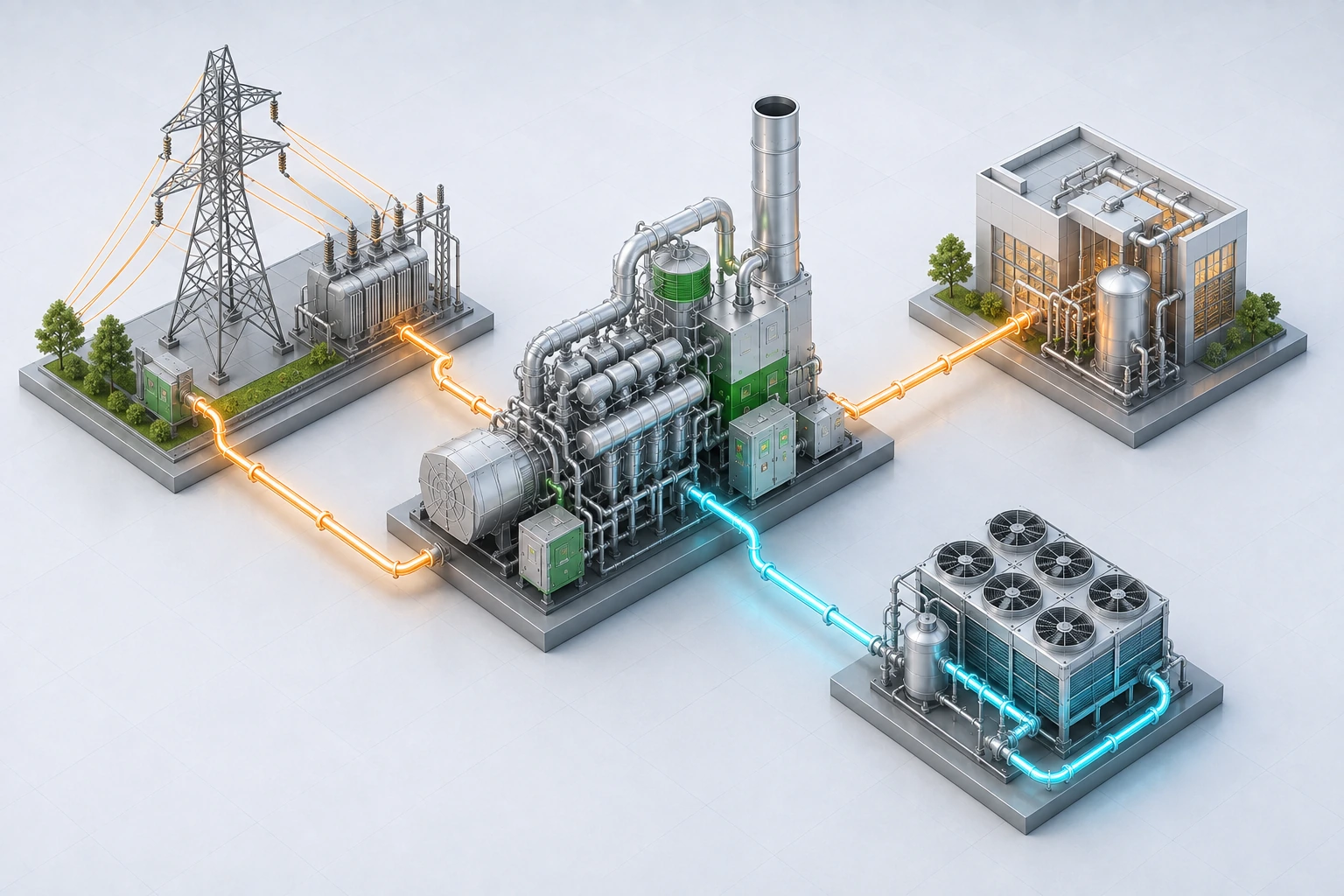
Conventional CHP produces electricity and heat. Sending some heat to an absorption chiller adds a third useful output: cooling. Combining electricity, heat and cooling is known as trigeneration.
How does it work without a large electric compressor?
An absorption chiller uses heat to drive a working-pair cycle. In common designs, water is the refrigerant and lithium bromide is the absorbent. Pumps and fans still consume electricity, but heat is the principal energy input to the cooling process.
Where does cooling have value?
- cold stores and food warehouses
- dairies, slaughterhouses and food-processing plants
- process cooling of machinery or process water
- air conditioning in larger buildings
- sites with surplus CHP heat in summer
Heat-source temperature must suit the chiller
Absorption technologies require different heat-source temperatures. A chiller should therefore not be chosen by cooling capacity alone. First check the CHP heat temperature, flow and available capacity, along with cooling-tower or other heat-rejection conditions.
Manufacturer examples
- Thermax offers hot-water-driven absorption chillers designed for integration with CHP, solar heat and industrial waste-heat sources.
- Yazaki Energy manufactures water-fired absorption chillers specifically used with CHP and other waste-heat sources.
- BROAD has absorption systems and CCHP references using exhaust, jacket water or hot water from energy plants.
The greatest benefit is often in summer
A settlement or greenhouse may take considerable heat in winter and almost none in summer. If the site also has cold storage or a process requiring cooling, trigeneration can significantly increase annual hours of useful heat consumption. This can matter more than the chiller's rated efficiency alone.
What does an actual project require?
The design must size the heat exchangers, pumps, chilled- and hot-water storage, cooling tower or dry cooler, water treatment, controls and backup electric cooling. Operation must remain stable when the CHP unit runs at part load.
Sources and further reading
- Thermax – Hot Water Driven Absorption Chiller
- Yazaki Energy – Water-Fired Thermal Chillers
- BROAD – CCHP and absorption references
- U.S. EPA – What Is CHP?
This article is for information. An actual installation requires a heat balance, equipment manufacturer data and checks of local conditions, permits and applicable regulations. The illustration shows a functional concept, not a detailed engineering design.