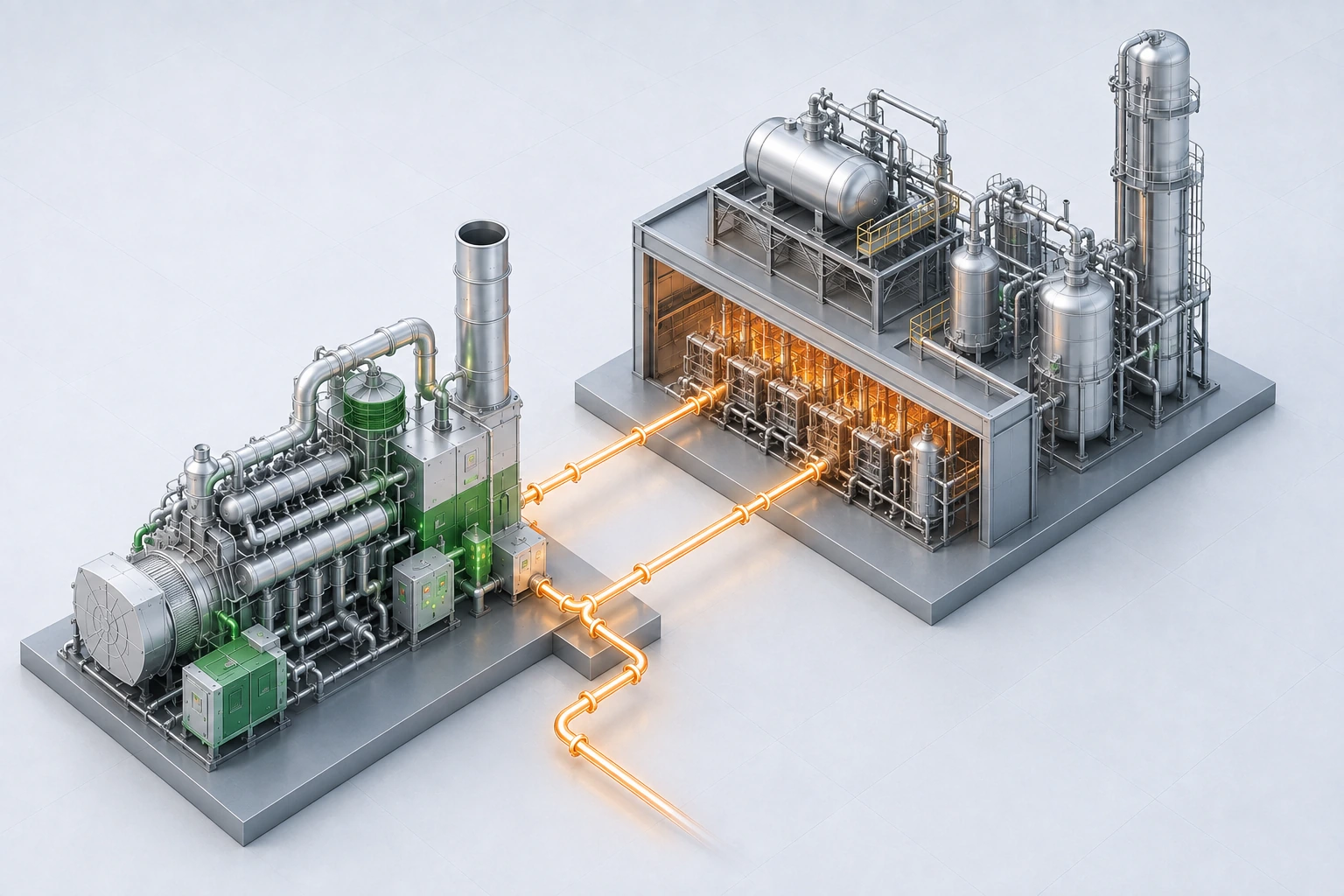
Industry generally buys heat because it reliably displaces energy otherwise supplied by gas, fuel oil or electricity. The strongest project therefore connects CHP heat to an existing process with measurable annual consumption.
Where does hot water fit most easily?
- preheating process or domestic water
- equipment washing and CIP systems
- heating production halls, warehouses and offices
- preheating drying air
- heating tanks and maintaining process temperature
- food and agricultural processes with continuous heat demand
When a process needs a higher temperature
Hot water from the engine circuit may be insufficient for a process requiring steam or a substantially higher temperature. Options then include exhaust heat, an additional heat exchanger, a hybrid arrangement with the existing boiler or a heat pump to raise the temperature. The aim need not be to eliminate the boiler, but to reduce its annual fuel use.
A heat exchanger separates the two systems
In most projects, the CHP heat circuit is not connected directly to the customer's process water. A heat exchanger provides hydraulic and safety separation, while separate pumps and controls allow each side to operate under its own conditions. This also simplifies pressure, water-quality and maintenance arrangements.
Why can industrial demand outperform seasonal heating?
A facility running two or three shifts may have a flatter heat-demand profile than a residential area and thus use heat for more hours each year. Conversely, an industrial customer may change production, reduce capacity or shut down a line, so the supply contract and contingency arrangements must inform the investment decision.
What data should be collected from a prospective customer?
Collect supply and return temperatures, peak and average capacity, hourly or at least monthly demand, current fuel and energy costs, distance from the CHP unit and backup-heating requirements. The greatest savings often come from the process operating for the most hours rather than the largest peak load.
Equipment examples
Such projects use established industrial heat exchangers, pump stations, thermal stores and controls. CHP manufacturers such as INNIO Jenbacher provide engine systems with useful heat recovery, while industrial processes have their own exchangers and equipment suited to the particular medium.
Sources and further reading
- U.S. EPA – What Is CHP?
- INNIO – Energy solutions and CHP applications
- European Commission – Heating and cooling
This article is for information. An actual installation requires a heat balance, equipment manufacturer data and checks of local conditions, permits and applicable regulations. The illustration shows a functional concept, not a detailed engineering design.