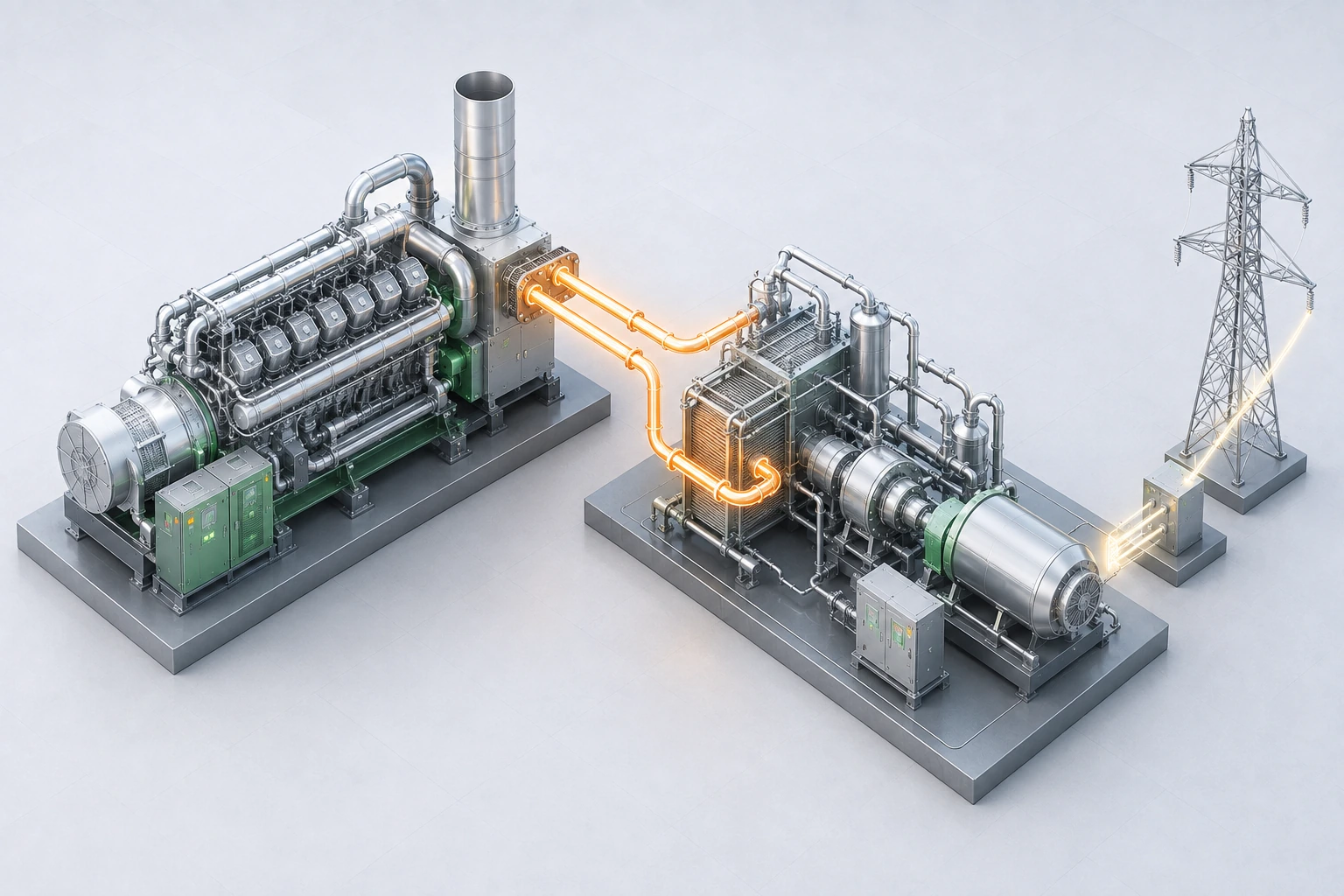
An Organic Rankine Cycle works in a similar way to a steam cycle, but uses a working fluid that evaporates at lower temperatures than water. Heat vaporises the fluid, which drives an expander or turbine connected to a generator. The fluid then condenses and returns to the cycle.
Where does ORC draw heat from a CHP unit?
Engine exhaust is usually the most valuable heat source. A heat exchanger transfers its heat to hot water or thermal oil, which then supplies the ORC system. Some modular designs can also use cooling-water heat to preheat the working fluid. The final arrangement depends on the engine and ORC suppliers.
When might ORC be worthwhile?
- CHP operates for many hours each year
- there is a steady surplus of higher-temperature heat
- no customer would pay more to use that heat directly
- additional electricity has value on site or in the grid
- there is enough room for heat exchangers, the ORC module and cooling system
ORC electricity is not free
The heat source exists, but the ORC system requires capital investment, auxiliary electricity, pumps, fans, maintenance and rejection of condenser heat. If the same heat can be sold to nearby industry or used more profitably in a dryer, ORC is not automatically the first choice.
Cascading use: ORC followed by another heat user
Heat need not be used only once. Lower-temperature heat remains after ORC conversion. If temperature levels allow it, this can supply a heat network, dryer, greenhouse or another low-temperature user. Such cascading can improve overall energy utilisation.
Manufacturer examples
- Turboden – ORC systems for renewables and waste-heat recovery, including gas-engine and gas-turbine heat.
- Orcan Energy – modular ORC “efficiency PACK” systems for engines and gas turbines; the supplier describes use of exhaust and engine-cooling heat.
What data does a supplier need for an initial assessment?
A preliminary assessment needs engine data, exhaust temperature and flow, available cooling-water heat, annual operating hours, ambient temperatures and cooling options. These establish realistic electrical output and annual generation; CHP nameplate capacity alone does not.
Sources and further reading
- Turboden – ORC systems and waste heat recovery
- Orcan Energy – Solutions for engines and gas turbines
- U.S. EPA – CHP Technologies / Waste Heat to Power
This article is for information. An actual installation requires a heat balance, equipment manufacturer data and checks of local conditions, permits and applicable regulations. The illustration shows a functional concept, not a detailed engineering design.