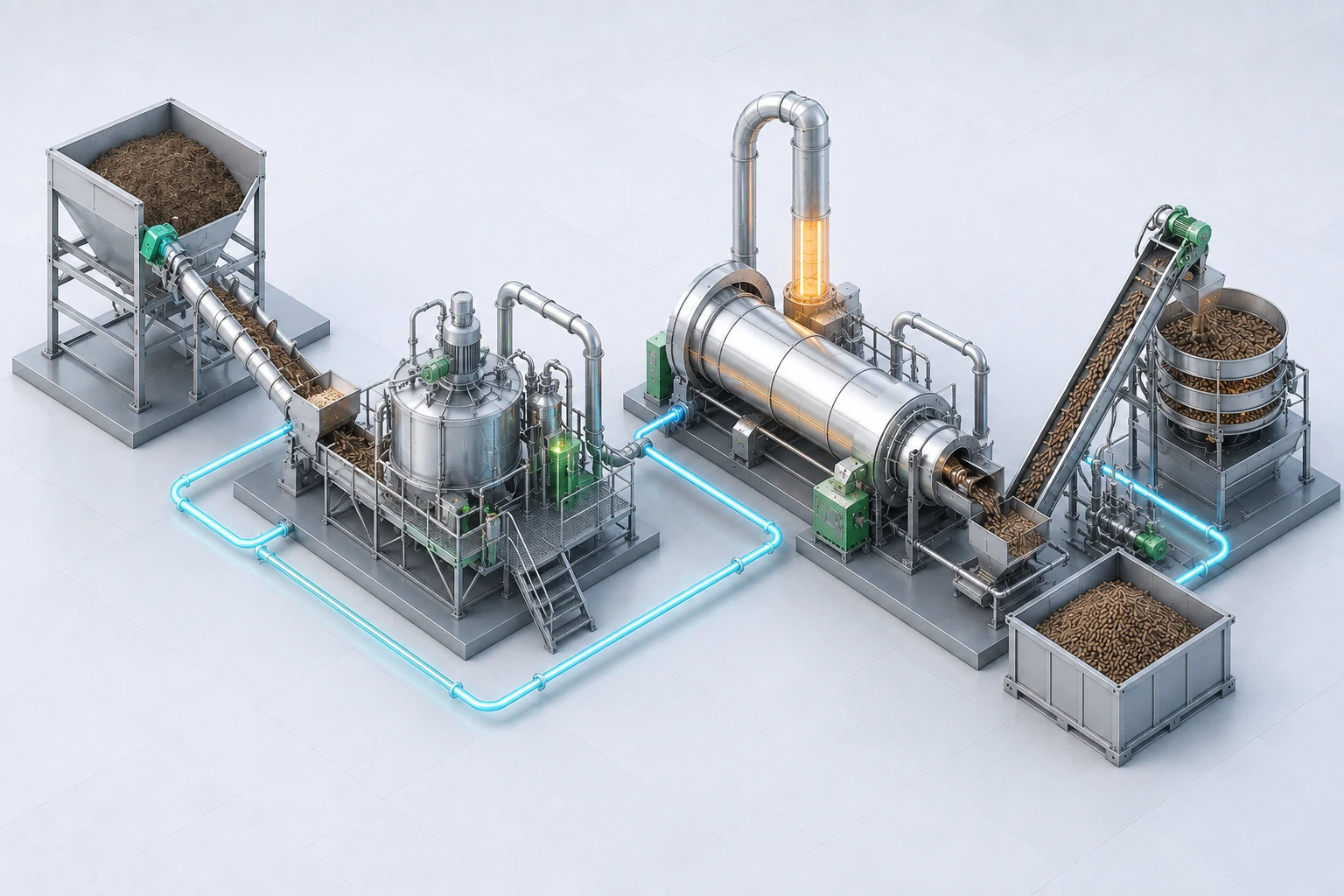
A pellet mill should not be the first machine specified. Before entering the die, material needs sufficiently consistent moisture, structure and particle size to form stable pellets. The line therefore often includes a buffer store, crushing or screening, feeding, mixing and conditioning.
Why make pellets?
Pellets are denser and more uniform than loose dried digestate. They are easier to store in a silo or bags, transport further and apply more precisely with a spreader. That may extend the market beyond the biogas plant's immediate area.
Conditioning is where the product takes shape
If analysis shows useful organic matter and nutrient levels in the base digestate, permitted additional components may be mixed in before pelletising. The aim may be a more consistent formulation or a product for a particular use. Vegetable production, orchards, vineyards and horticulture could be potential markets, but the formulation requires agronomic and regulatory confirmation; no single pellet suits every crop.
Drying and pelletising are separate processes
This distinction matters when selecting equipment. RHINO, for example, is a dryer: its task ends with producing dry material. A separate preparation and pelletising line follows. The same applies to most belt and other dryers.
Examples of pellet mill manufacturers
- SALMATEC – a German manufacturer that explicitly offers MAXIMA pellet mills for fermentation residues from biogas plants.
- Dorset Green Machines – offers pelletising alongside drying as part of wider organic-material processing solutions.
- AMANDUS KAHL – German flat-die pellet mills are also used in the organic fertiliser industry.
- ANDRITZ – a broad range of industrial and biomass pellet mills, alongside separate technologies for organic waste and digestate treatment.
What to define before requesting a machine quotation
- the quantity of dry material per hour and per year
- incoming moisture content and its variation through the year
- desired pellet diameter and mechanical strength
- whether other components need to be mixed in
- cooling, screening, storage and packaging methods
- the product intended for sale and the applicable rules
Only with those answers can a manufacturer test a sample and size the die, rollers, drive and complete line.
Sources and further reading
- SALMATEC – Fermentation residue
- Dorset Green Machines – organic waste processing and pelleting
- AMANDUS KAHL – organic fertiliser and pellet mills
- ANDRITZ – Pellet mills, biomass
This article is for information. An actual installation requires a heat balance, equipment manufacturer data and checks of local conditions, permits and applicable regulations. The illustration shows a functional concept, not a detailed engineering design.