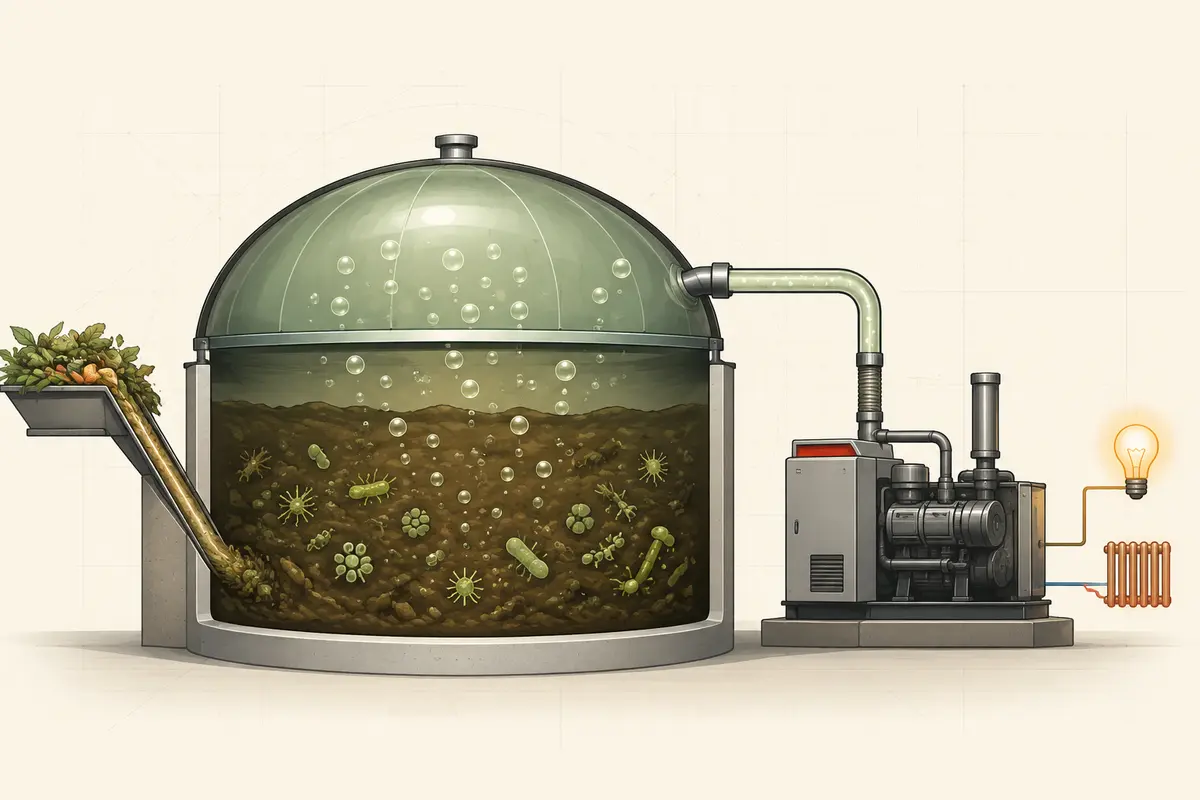
Biogas is a mixture of gases formed when organic matter decomposes anaerobically, without oxygen. Methane is its most important component because it accounts for most of the gas's energy content. Biogas also contains carbon dioxide and smaller amounts of water vapour, hydrogen sulphide and other compounds.
From organic feedstock to gas
The process takes place in an enclosed vessel, usually called a digester or fermenter. Suitable feedstocks are fed into it, such as solid manure, slurry, agricultural residues, food industry by-products or separately collected biowaste. The contents are mixed and kept at a temperature suitable for the microorganisms.
Different groups of microorganisms gradually convert complex organic compounds into simpler substances; the final group produces methane. Stable production therefore depends on balanced feeding of the digester, temperature, pH, retention time and the absence of substances that could disrupt the biology of the process.
How is biogas used?
After basic moisture and contaminant removal, biogas can be used in a combined heat and power (CHP) unit to produce electricity and heat. It can also be upgraded to biomethane, a high-methane gas suitable for use in the gas grid or transport if it meets the applicable requirements.
The process also produces digestate. This is the material left after digestion; if managed correctly, it can retain valuable nutrients and be used in agriculture.
Sources and further reading
- T. Al Seadi et al., Priručnik za bioplin, BiG>East, 2008.
- U.S. EPA – How Does Anaerobic Digestion Work?
This article is for information only. It does not replace design work, a professional assessment, or legal, environmental or financial advice for a specific project.