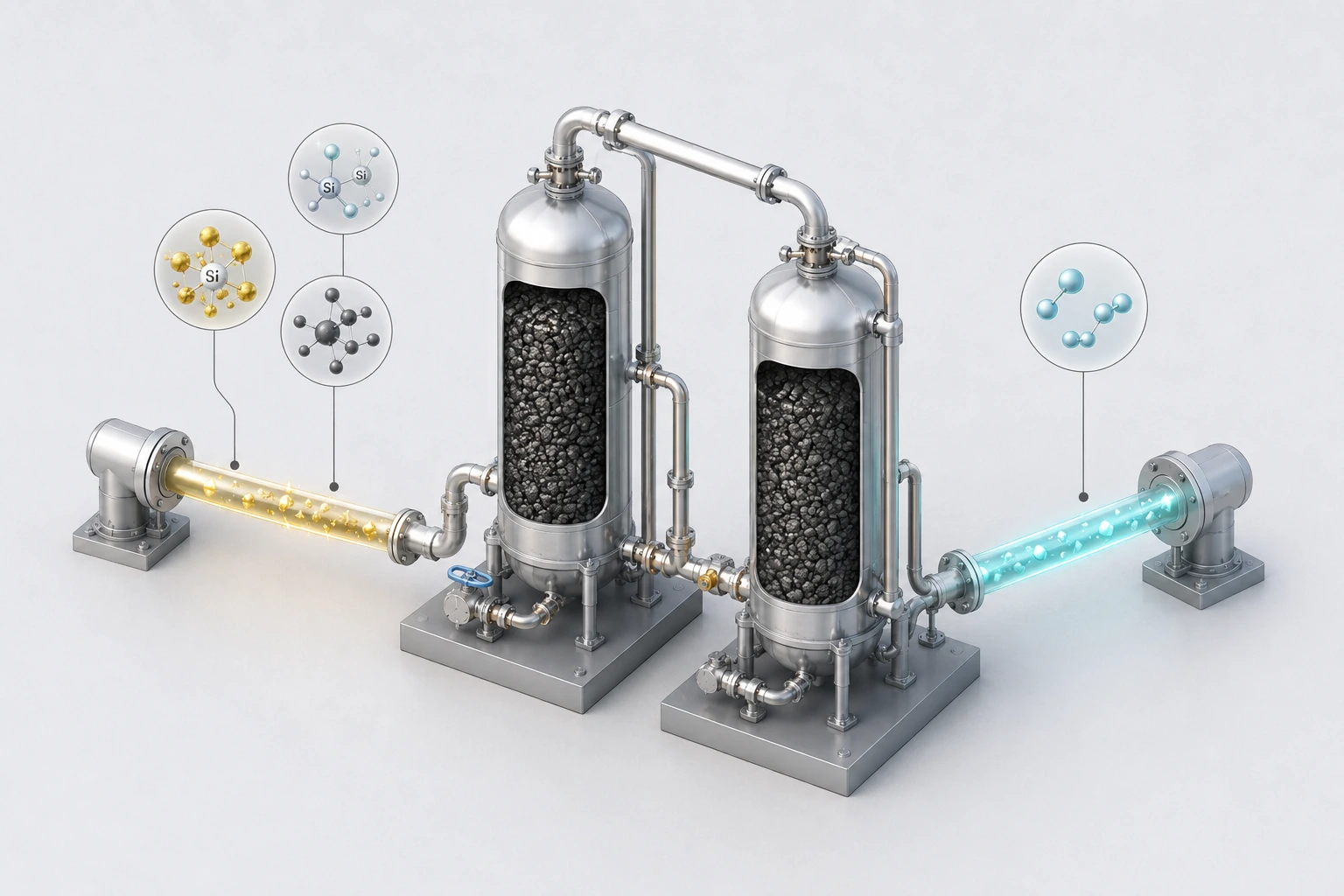
Activated carbon is one of the most common and flexible methods for final biogas cleaning. It is compact, has no complex moving parts and can remove low concentrations of various contaminants. Yet “activated carbon” covers a wide range of different products.
Carbon grades are not interchangeable
CarboTech states that sulphur compounds require specially impregnated activated carbon, while non-impregnated media are better suited to many VOCs. DESOTEC also describes a typical arrangement using different media for siloxanes/VOCs and H₂S. Media selection should therefore be based on the actual gas composition.
H₂S and chemisorption
With impregnated carbon, H₂S is not retained solely by physical adsorption. It reacts with the impregnant and oxygen to form more stable sulphur compounds that remain on the medium. Capacity therefore depends on moisture, oxygen, temperature, H₂S concentration and the carbon's specific chemistry.
Siloxanes and VOCs
Siloxanes, terpenes and many organic compounds are removed mainly by physical adsorption. In biogas from municipal waste, siloxanes can be critical because combustion turns them into hard mineral deposits. Activated carbon is therefore often placed immediately upstream of the CHP engine or sensitive upgrading equipment.
Why are drying and preliminary desulphurisation important?
If wet gas with a high H₂S load reaches the filter, media life may be very short. In many projects it is more economical to remove most of the sulphur by microaeration, iron salts or a scrubber, dry the gas, and reserve activated carbon for final polishing. This makes the best use of the costly adsorbent.
One vessel or two?
A two-vessel series arrangement gives better control over contaminant breakthrough. The first vessel takes the main load and the second acts as a guard bed. When the first medium is replaced, the second vessel can temporarily become the lead vessel. This arrangement helps maintain stable gas quality.
Manufacturers
CarboTech, Jacobi and DESOTEC offer specialist solutions for biogas. A project comparison should consider not only the price per kilogram of carbon, but also capacity for the specific contaminant, operating conditions, replacement method and disposal or reactivation of the spent medium.
Sources and further reading
- CarboTech – Biogas desulphurization with activated carbon
- Jacobi – Biogas purification
- DESOTEC – Biogas and renewable energy
This article is for information only. The final cleaning specification must be based on analysis of the actual gas composition, the end user's requirements, safety rules and confirmation from equipment manufacturers. The illustration shows the functional principle, not a construction design.