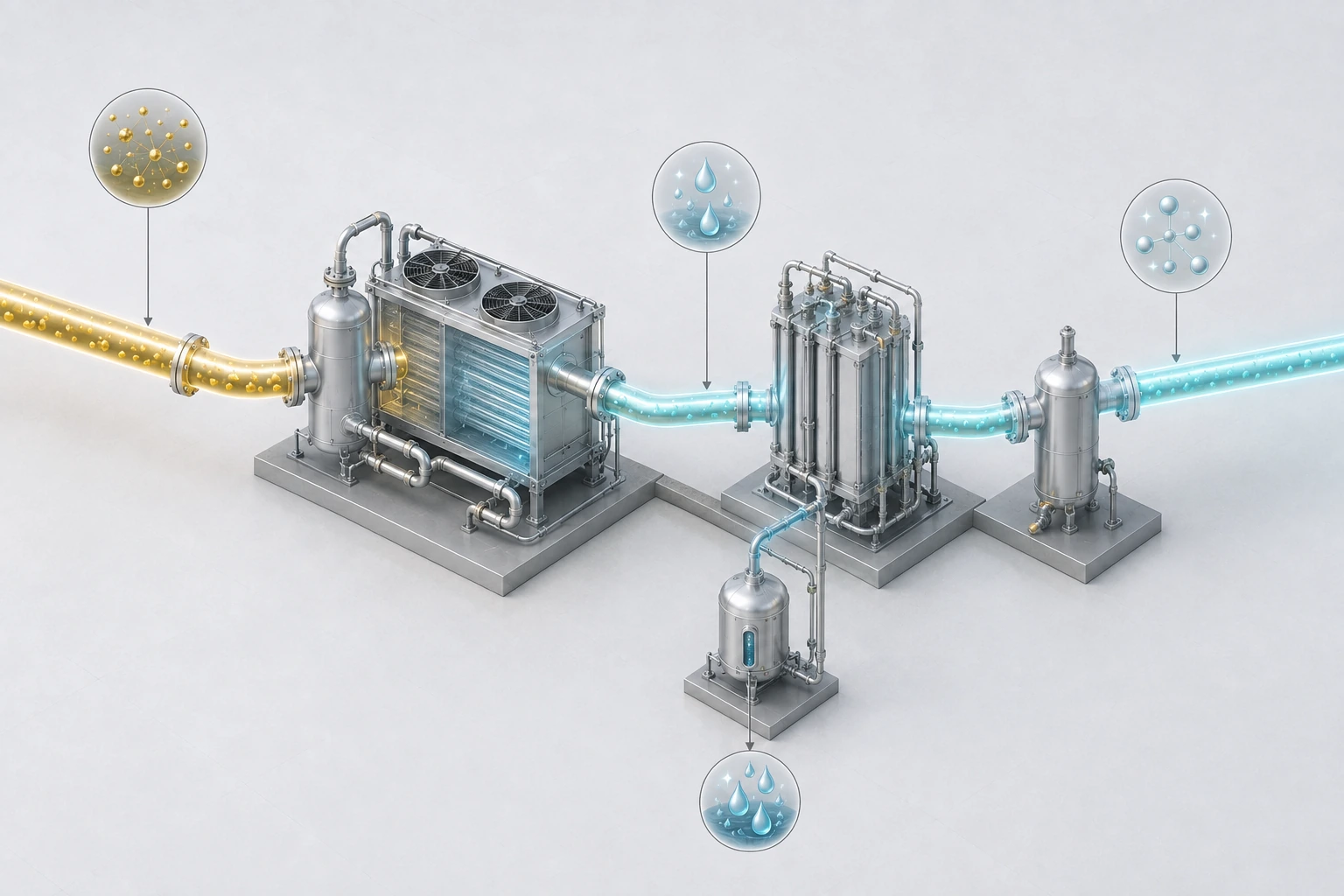
Biogas leaving the digester is warm and almost saturated with water vapour. As it cools in external pipework, some vapour becomes liquid condensate. If the system is not designed to handle this, water collects at low points, increases pressure losses, carries corrosive compounds and can cause serious equipment problems.
First step: controlled condensation
Rather than letting condensation occur unpredictably in pipework, the gas is deliberately cooled in a heat exchanger or chiller. Once its temperature falls below the dew point, water condenses and is removed by a separator. The EPA lists refrigerated and adsorption drying among standard moisture-removal methods.
Design the pipeline to help remove condensate
Correctly graded pipe runs, adequate fall, condensate pots and automatic or safely operated manual drains matter as much as the chiller itself. At biogas plants, condensate can contain dissolved H₂S and other compounds; it must be routed into an appropriate process system rather than discharged without control.
Why is the gas often reheated after cooling?
After condensate separation, modest reheating increases the margin above the dew point and reduces the risk of water condensing again in a filter or compressor. Bright Renewables, for example, combines moisture removal, compression and carbon filters upstream of membrane upgrading in its pretreatment line.
When is deeper drying needed?
For CHP, well-designed condensation drying often suffices if it meets the engine specification. Biomethane, high-pressure systems and especially liquefaction may require a much lower water content. Adsorption dryers, molecular sieves or other regenerative processes can then follow the cooler.
Equipment to allow for
- gas cooler or chiller
- droplet and condensate separator
- safe condensate pots and drainage
- temperature, pressure and, where needed, dew-point measurement
- reheater or thermally integrated compression
Sources and further reading
This article is for information only. The final cleaning specification must be based on analysis of the actual gas composition, the end user's requirements, safety rules and confirmation from equipment manufacturers. The illustration shows the functional principle, not a construction design.