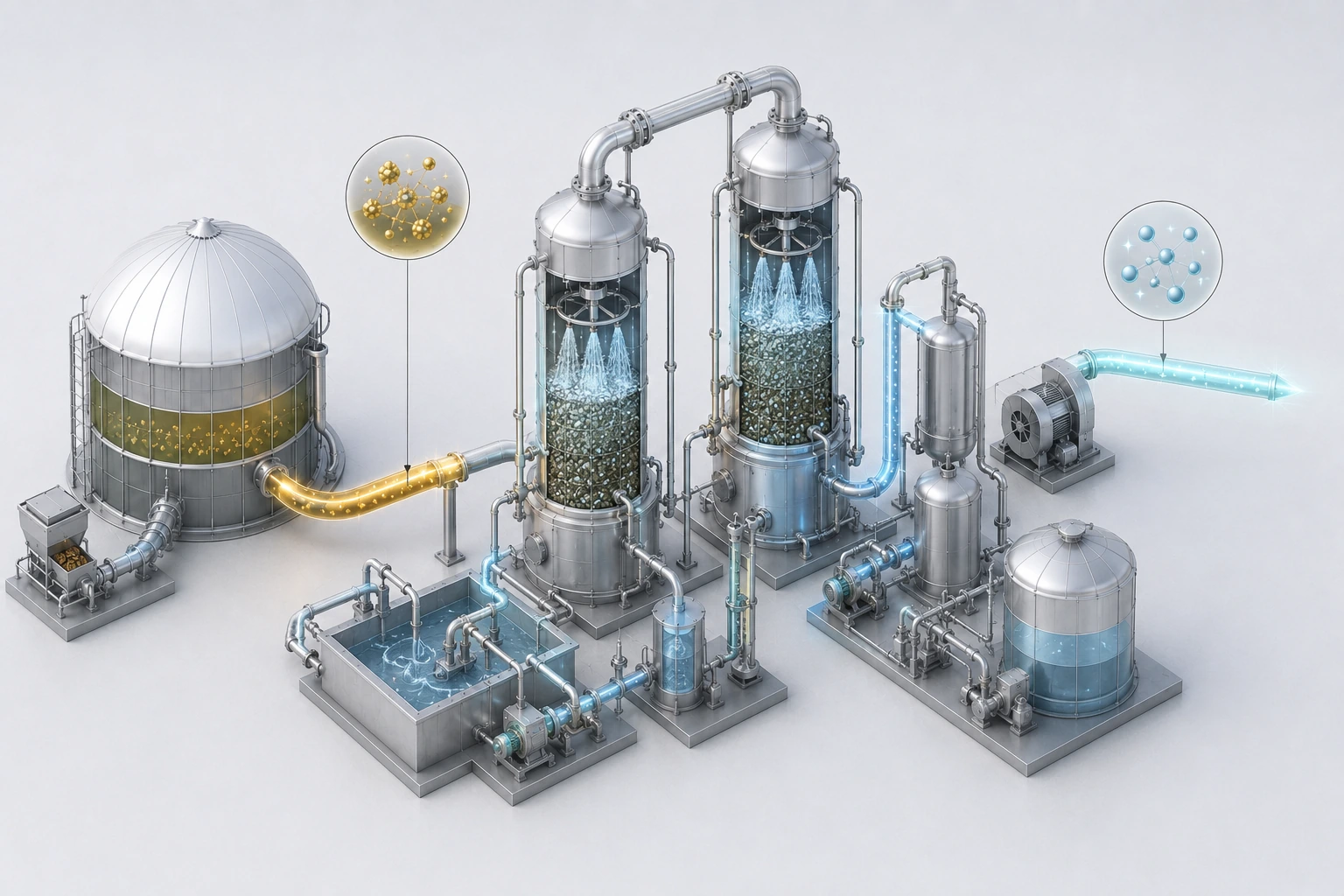
When a plant handles a large biogas flow or H₂S concentrations are too high for economical activated-carbon use, an external scrubber becomes relevant. Rather than using a consumable medium in a small vessel, it continuously transfers H₂S from the gas into a liquid phase, then treats or regenerates the absorption liquid.
Biological scrubbers
Paques' THIOPAQ combines H₂S absorption with biological regeneration of an alkaline solution and production of elemental sulphur. According to the manufacturer, the technology is used in biogas and biomethane applications and can handle a wide range of inlet H₂S loads.
Biogasclean and the moving-bed approach
Biogasclean's BMR uses a biological moving-bed reactor. After compression, cooling and controlled air addition, the gas enters through diffusers and H₂S is biologically oxidised to elemental sulphur. Such systems are of interest where gas flow and sulphur load are substantial.
Chemical scrubbing
Chemical scrubbers use an absorption liquid that binds H₂S through a chemical reaction. Depending on the chemistry, the reagent may be regenerated or consumed. Rapid response to changing loads is an advantage; chemical consumption, waste streams and the need for corrosion-resistant equipment can be disadvantages.
What matters in selection?
- raw gas flow in Nm³/h and its operating range
- average and peak H₂S concentrations
- target outlet H₂S concentration
- availability of air, oxygen, chemicals and water
- sulphur production and its potential market or disposal route
- electricity consumption and required pressure
- need for standby capacity or a bypass
Scrubber plus final polishing
A common arrangement uses a scrubber to remove most of the sulphur and a smaller activated-carbon filter for final polishing. This reduces carbon replacement frequency while maintaining a low and stable outlet concentration.
Sources and further reading
- Paques – THIOPAQ biogas desulfurization
- Paques – Gas desulfurization
- Biogasclean – Biological Moving Bed Reactor
This article is for information only. The final cleaning specification must be based on analysis of the actual gas composition, the end user's requirements, safety rules and confirmation from equipment manufacturers. The illustration shows the functional principle, not a construction design.