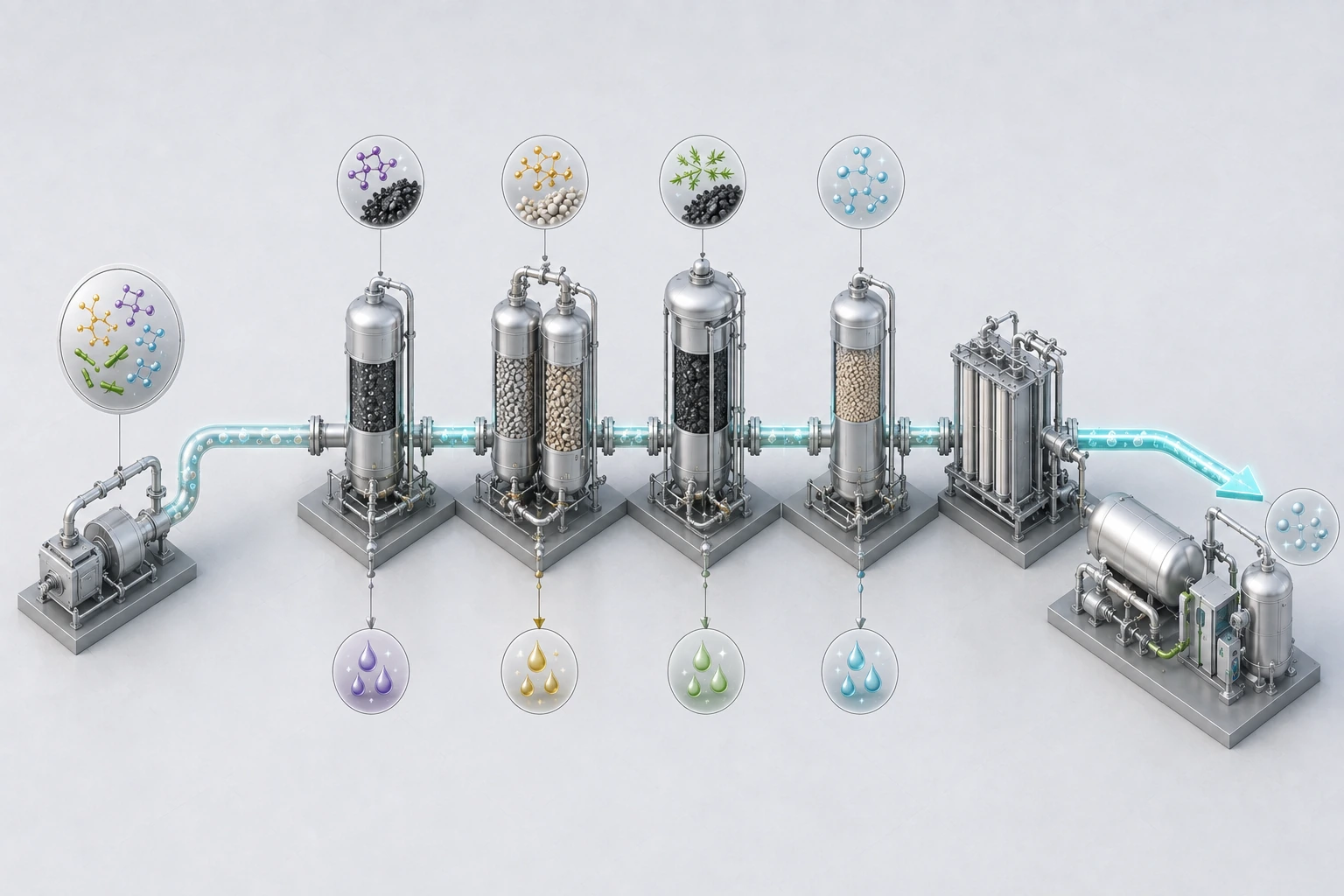
Discussions of biogas cleaning often stop at H₂S and water. Yet with many gas sources, traces of other compounds determine how reliably an engine, turbine, membrane or fuel cell will operate.
Siloxanes – trace amounts, substantial engine damage
Siloxanes are particularly relevant in sewage sludge, household waste and industrial streams associated with cosmetics and silicone products. The EPA warns that combustion can turn them into hard glass- or sand-like deposits on equipment surfaces. Their concentration in such sources must therefore be measured rather than assumed.
VOCs and terpenes
Volatile organic compounds can come from feedstocks, waste, landfill gas or industrial residues. Some mainly cause odour problems, while others burden adsorbents, catalysts and membranes. DESOTEC and Jacobi therefore offer media for combined removal of VOCs, terpenes, siloxanes and other trace substances.
Ammonia
NH₃ may occur with nitrogen-rich feedstocks. Its concentration depends on pH, temperature and process composition. In the gas system it can contribute to corrosion and unwanted reactions; for highly sensitive downstream technologies it may be subject to a specification limit.
How are trace contaminants removed?
Adsorption is a common approach, often using several different media. One filter may be optimised for H₂S, another for VOCs and siloxanes. Drying the gas before adsorption often improves media capacity. Advanced systems may also use regenerable adsorbents or dedicated polishing stages.
Measure before sizing
A designer should not copy a filter specification from one plant to another. Agricultural biogas from manure and maize silage can have a very different trace-contaminant profile from biogas at a wastewater treatment plant. Analysing raw gas over a sufficiently long period reduces the risk of choosing the wrong adsorbent.
Manufacturers
Jacobi, CarboTech and DESOTEC offer separate solutions for H₂S, siloxanes and VOCs in biogas. Selection should use data for the actual gas and operating conditions, not a generic “carbon capacity” figure from a catalogue.
Sources and further reading
- U.S. EPA – AgSTAR Operator Guidebook
- Jacobi – Biogas purification
- CarboTech – Biogas
- DESOTEC – Biogas and renewable energy
This article is for information only. The final cleaning specification must be based on analysis of the actual gas composition, the end user's requirements, safety rules and confirmation from equipment manufacturers. The illustration shows the functional principle, not a construction design.