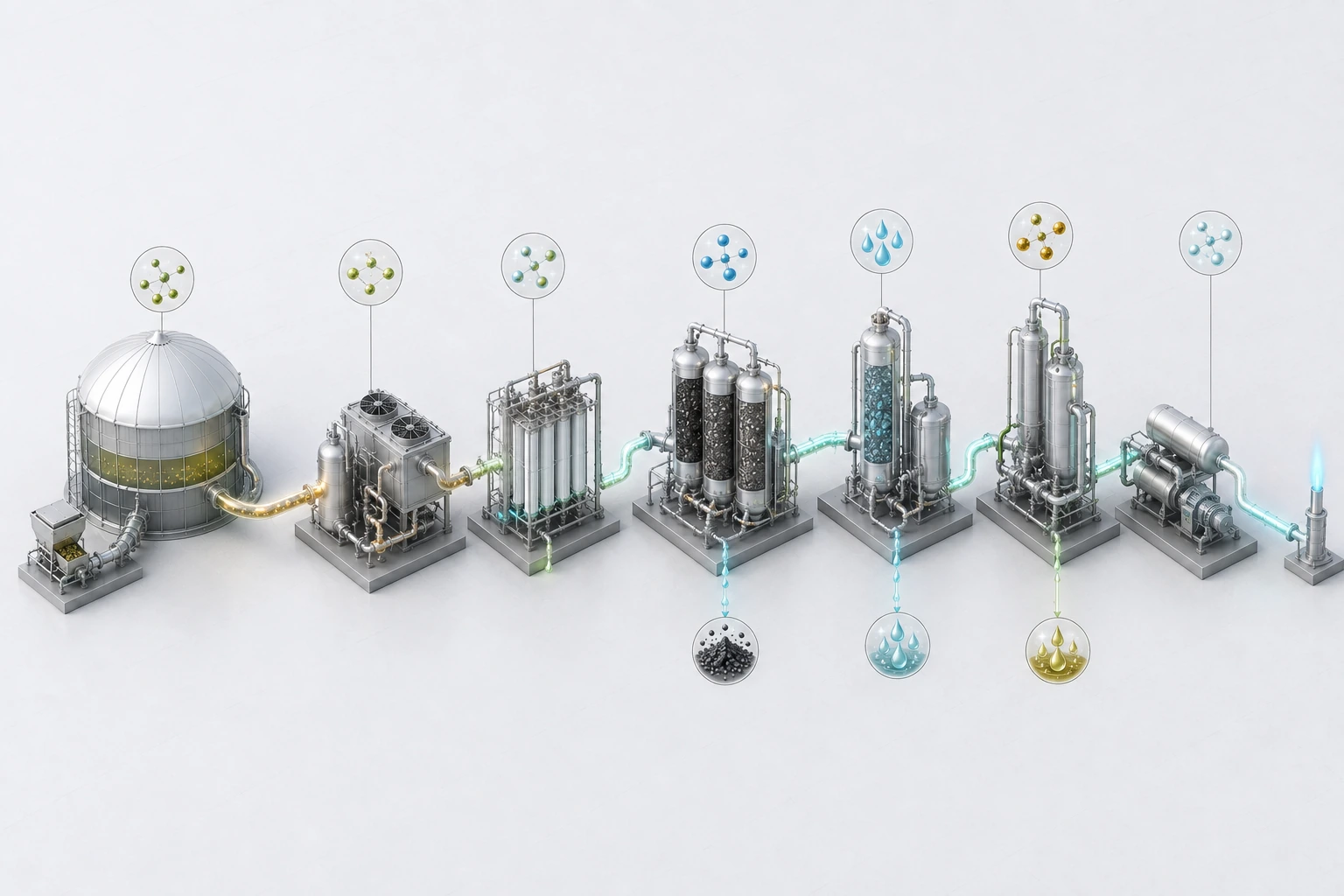
Producing biomethane, rather than simply protecting a CHP engine, calls for a different level of gas treatment. After removing moisture, H₂S and problematic trace compounds, much of the CO₂ must be separated and the CH₄ concentration raised to the specification for grid injection, fuel use or further processing.
Membrane separation
Polymer membranes let CO₂ and certain other gases permeate faster than methane. A compressor creates the necessary partial-pressure difference, while multiple membrane stages increase methane recovery and product purity. Air Liquide and Bright Renewables offer commercial membrane systems for biogas. Their advantages include modularity and relatively straightforward continuous operation; effective pretreatment and compression costs remain critical.
PSA – pressure swing adsorption
In PSA, pressurised gas passes through an adsorbent that preferentially retains CO₂ and certain contaminants. Once the bed is saturated, pressure is reduced to regenerate the medium. Several vessels operate in cycles to maintain continuous product flow. Greenlane offers PSA alongside water wash and membranes, illustrating the need to select technology for the specific project.
Water wash
CO₂ and H₂S are more soluble in water than methane. In water wash systems, gas contacts water under pressure; absorbed gases are then released as the water is regenerated. The process can handle variations in raw gas, but requires pumps, columns and water management.
Amine scrubbing
Amine solutions chemically bind CO₂. The loaded solution is then heated in a regenerator, releasing CO₂ and returning the amine to the process. Deep CO₂ removal at relatively low gas pressure can be an advantage, while heat demand and a more complex chemical system are drawbacks.
Methane purity is not the only metric
Investors also need to consider methane recovery and slip, electricity and heat demand, capacity at minimum and maximum flow, sensitivity to H₂S and VOCs, commissioning, maintenance and the composition of the CO₂-rich off-gas. Raw biogas quality can decide between two technologies that appear to deliver the same CH₄ percentage on paper.
Pretreatment remains essential
Bright removes moisture and uses activated carbon for H₂S and VOCs upstream of its membranes. Air Liquide describes pretreatment systems for VOCs, siloxanes and other contaminants. Upgrading therefore follows basic gas cleaning; it does not replace it.
Manufacturer examples
Greenlane Renewables commercially offers water wash, PSA and membranes. Bright Renewables uses three-stage membranes and integrated gas treatment. Air Liquide manufactures its own hollow-fibre membranes and complete upgrading units. Selection should be based on performance with the actual gas composition, rather than a technology label alone.
Sources and further reading
- Greenlane Renewables – Why Greenlane?
- Bright Renewables – Membrane biogas upgrading
- Bright Renewables – Gas treatment
- Air Liquide – Biogas purification technologies
- U.S. EPA – AgSTAR Operator Guidebook
This article is for information only. The final cleaning specification must be based on analysis of the actual gas composition, the end user's requirements, safety rules and confirmation from equipment manufacturers. The illustration shows the functional principle, not a construction design.