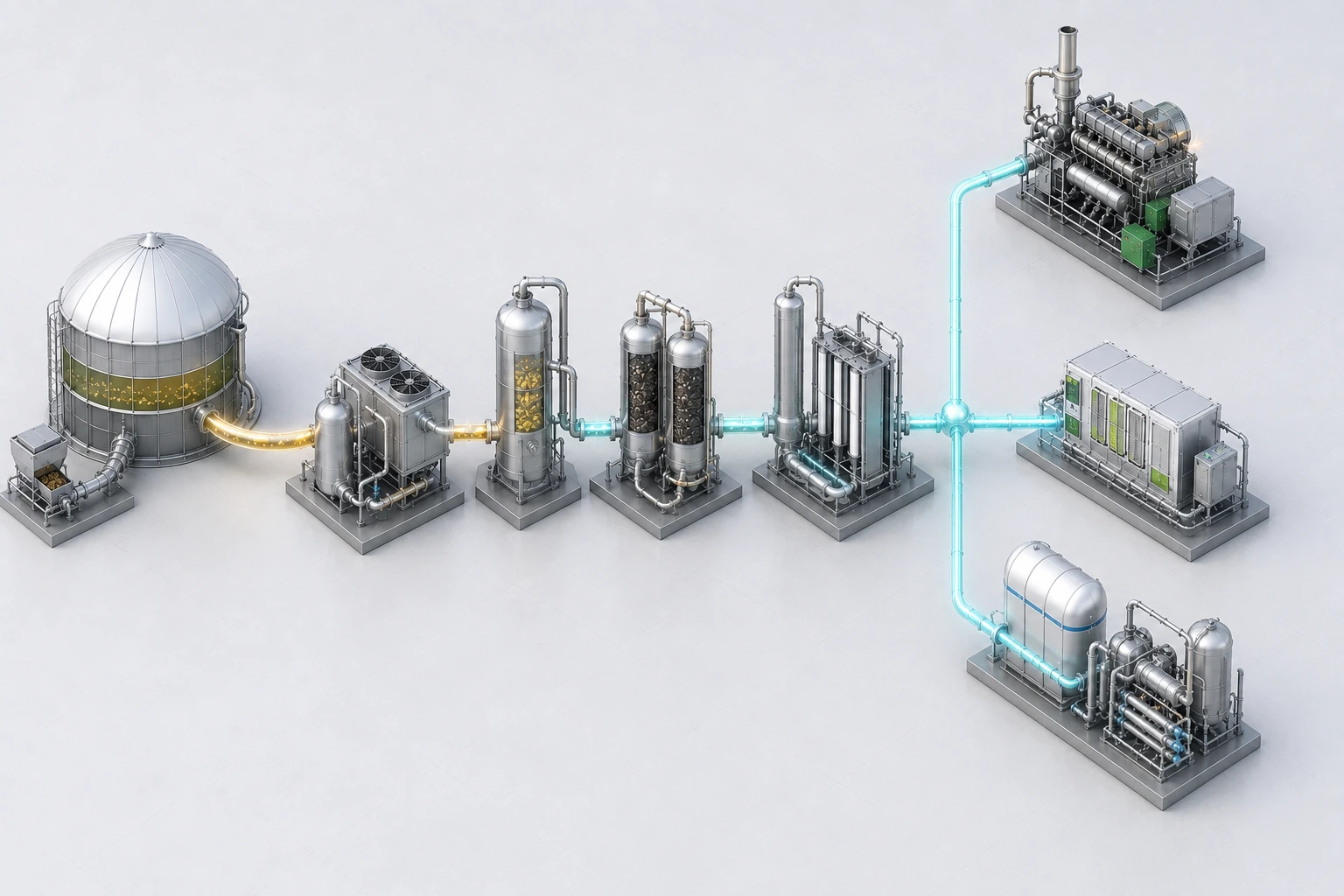
The central question in treatment design is what the gas will be used for. CHP engines, fuel cells, natural gas grids and Bio-LNG plants have different limits for moisture, sulphur, CO₂ and trace compounds. The treatment system should therefore be designed backwards from the final product to the digester.
CHP: robust, but not unaffected by contaminants
For a gas engine, reliable condensate removal, sufficiently low H₂S and, for gas from municipal feedstocks, siloxane control are usually critical. The engine manufacturer and warranty terms set the precise limits. If sulphur levels are high, upstream desulphurisation followed by an activated-carbon polishing stage is often more economical than a large carbon filter without pretreatment.
Fuel cells: deep polishing
Fuel cells can be particularly sensitive to sulphur compounds and catalyst poisons. FuelCell Energy describes a treatment system that removes siloxanes and sulphur compounds from digester gas. Its carbonate fuel cell system can use biogas without necessarily removing all CO₂, because CO₂ participates in the electrochemical process. This illustrates how treatment requirements depend on the fuel cell type.
Biomethane for grid injection or CNG
For grid injection or CNG use, most CO₂ must be removed and local specifications for calorific value, moisture, H₂S, oxygen and other components met. Upgrading is therefore combined with continuous gas analysis, recirculation or flaring of off-spec gas, and a metering and pressure-regulating station.
Bio-LNG: an additional treatment stage
Liquefaction requires very deep removal of components that could freeze or cause problems at cryogenic temperatures. Bright Renewables states that, following conventional upgrading, its additional TPSA polishing reduces CO₂ to less than 50 ppm before liquefaction. Water and other trace compounds must also meet the liquefaction equipment specification.
Four different treatment chains from one raw gas
- CHP: cooling and water separation → H₂S control → siloxane/VOC removal where needed.
- Fuel cell: drying → very deep desulphurisation → removal of siloxanes and catalyst poisons.
- Grid-quality biomethane: pretreatment → CO₂ removal by upgrading → analysis and polishing to the grid specification.
- Bio-LNG: pretreatment → upgrading → deep CO₂/H₂O polishing → liquefaction.
Manufacturers and examples
FuelCell Energy is an example of integrated gas cleaning for fuel cells. Bright Renewables provides gas treatment, membrane systems and Bio-LNG polishing. Air Liquide combines membrane upgrading with biomethane and liquefaction solutions, while adsorbent suppliers such as DESOTEC, Jacobi and CarboTech provide pretreatment and polishing media.
Sources and further reading
- FuelCell Energy – Biogas fuel cell power plants
- FuelCell Energy – Fuel flexibility of carbonate fuel cells
- Bright Renewables – Bio-LNG polishing & liquefaction
- Air Liquide – Biogas purification technologies
- DESOTEC – Biogas and renewable energy
This article is for information only. The final cleaning specification must be based on analysis of the actual gas composition, the end user's requirements, safety rules and confirmation from equipment manufacturers. The illustration shows the functional principle, not a construction design.