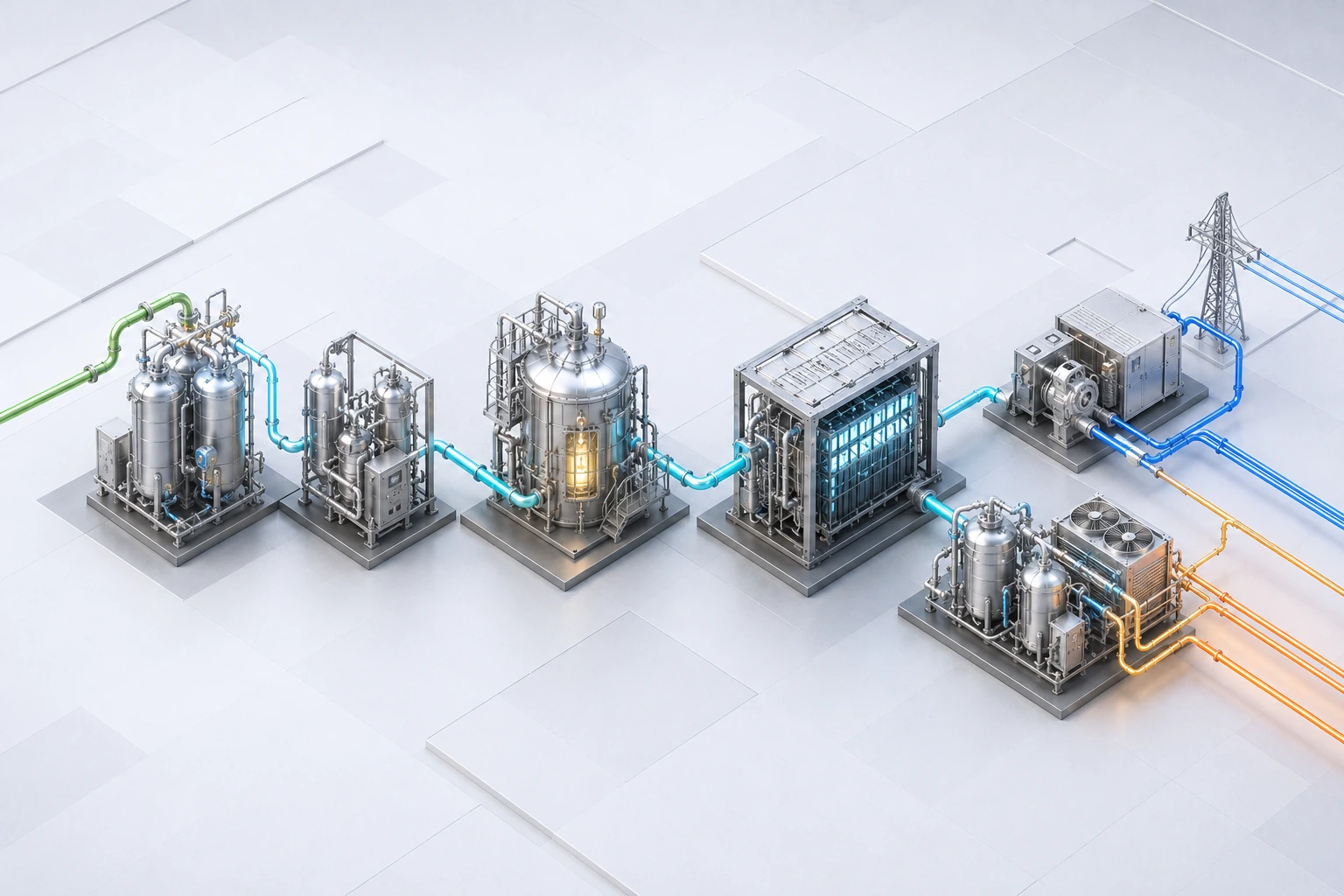
A reciprocating gas engine in a CHP unit mechanically drives a generator. A fuel cell works differently: fuel energy is converted to electricity electrochemically rather than first driving a piston or turbine. Heat is still released, so a well-designed system can provide both electricity and useful heat.
Methane is first converted into fuel suitable for the cell
Biogas consists mainly of methane and carbon dioxide. In stationary systems, methane is converted in a reformer or within the high-temperature cell into a hydrogen-rich gas mixture. The electrochemical reaction then produces direct-current electricity, which an inverter adapts for the grid and on-site loads.
High-temperature technologies such as SOFC and MCFC can be suitable because they support internal or external methane reforming and produce higher-temperature heat. Low-temperature PEM cells generally require hydrogen produced and purified beforehand, making their fuel-processing chain more complex.
Biogas cleaning is essential for reliable operation
Raw digester gas must not be fed directly into a fuel cell. Condensate and particles need to be removed, while hydrogen sulphide must be reduced to very low levels. Depending on the feedstock, siloxanes, halogenated compounds, ammonia and other trace substances that could poison catalysts or form deposits also need control.
Limits vary by model. The project must therefore start from the chosen manufacturer's specification, analysis of the actual biogas and a clear plan for replacing adsorbents and filters. Cutting gas-preparation costs can lead to an expensive failure of the energy module.
What can a fuel cell offer?
- high electrical efficiency without a conventional combustion cycle and mechanical generator
- quiet operation with little vibration and low local noise
- very low NOₓ and particulate emissions compared with conventional engines
- modular capacity expansion in some designs
- heat recovery for the digester, hot water or an industrial process
The greatest benefit arises where the plant has steady base electricity demand and a real heat user. High electrical efficiency alone does not guarantee a sound investment if the system is frequently unavailable or gas preparation consumes excessive energy and consumables.
Why do gas engines remain prevalent?
Gas engines have a large installed base, established service networks and well-understood behaviour with varying biogas composition. Fuel cells generally require higher initial investment, more thorough gas cleaning and specialist maintenance. Some designs warm up slowly and are unsuited to frequent starts and stops.
They should therefore not be presented as a universal replacement. Fuel cells are another conversion option that may have an advantage where electrical efficiency, low noise, low local emissions and continuous operation matter, provided the site can supply suitable gas and long-term technical support.
What to check before requesting a quotation
A technical and economic comparison should include biogas composition and variability, cleaning-system energy use, module availability, stack replacement cost, heat value, service response and islanded operation capability. Comparison with a CHP engine must use the same annual gas quantity and availability assumptions.
Sources and further reading
- U.S. EPA – CHP Technologies
- U.S. Department of Energy – Improving Desulfurization to Enable Fuel Cell Utilization of Digester Gases
- U.S. Department of Energy – Expanding the Use of Biogas with Fuel Cell Technologies
This article is for information. Required gas quality, capacity, efficiency, service life and maintenance regime must be confirmed for the particular technology and biogas composition. The illustration shows a functional principle, not a specific commercial device.