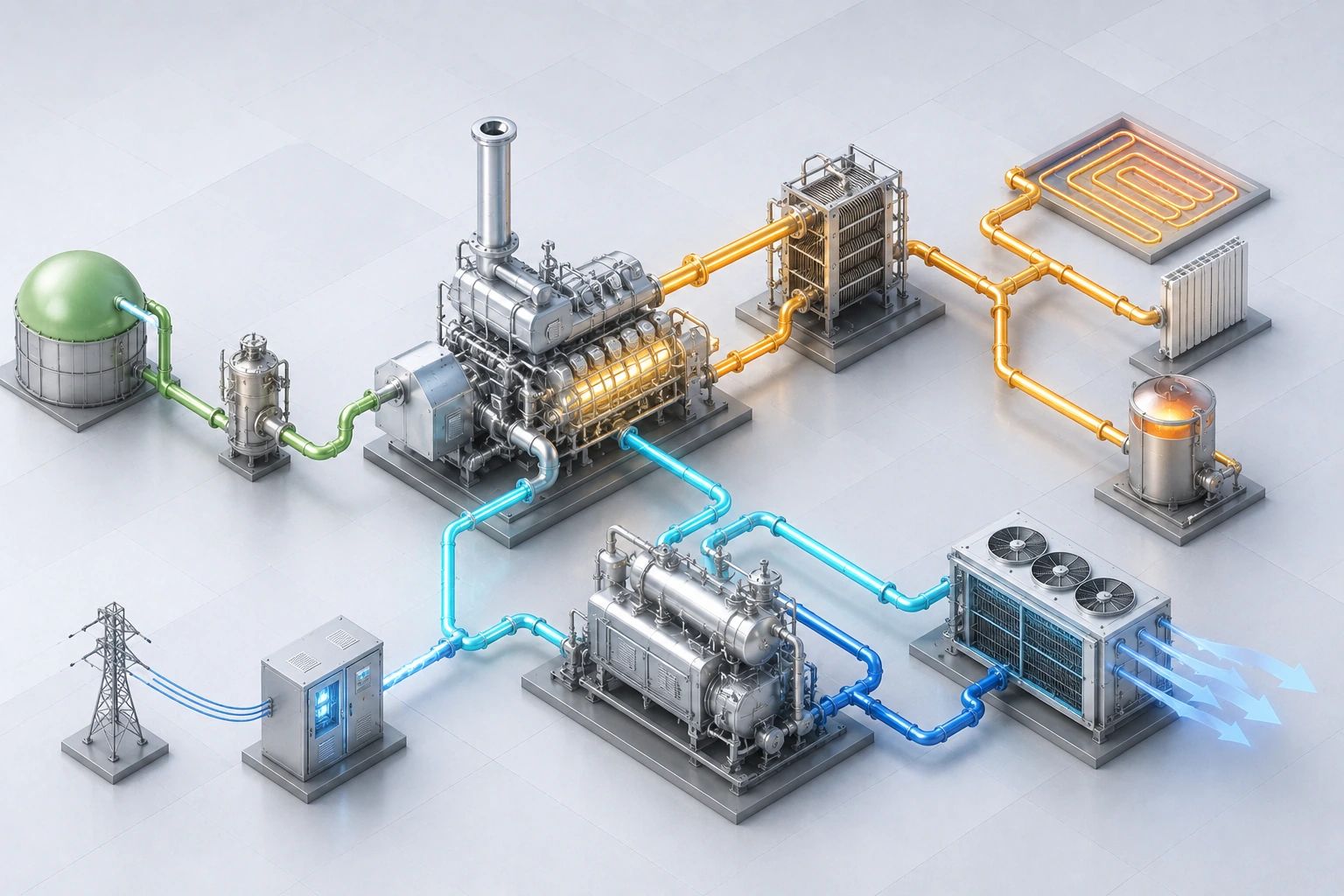
A CHP unit produces electricity and heat. In winter, the digester and buildings can use that heat, but it often goes unused in summer. An absorption chiller can use some of it to produce cooling and increase the hours of useful operation.
How does heat produce chilled water?
Unlike a conventional vapour-compression chiller driven mainly by electricity, an absorption chiller uses heat as its primary energy source. In a closed cycle, refrigerant evaporates at low pressure and removes heat from the chilled-water circuit, then is absorbed, heated and separated again.
Water–lithium bromide working pairs are often used for chilled water above freezing, while ammonia–water systems serve lower temperatures. Selection depends on the required temperature, available heat and safety requirements.
Where does the driving heat come from?
A gas engine supplies heat through its cooling water and exhaust; a turbine primarily offers hot exhaust. Temperature, flow and heat-recovery arrangement determine whether a single-stage or more complex absorption process is suitable. Not all waste heat has the same value.
Where does trigeneration make sense?
- food processors needing steam, hot water and chilled water at the same time
- cold stores, dairies and agricultural processing
- commercial or public buildings with summer air-conditioning loads
- processes requiring cooling for stable year-round production
The strongest candidate has prolonged, predictable cooling demand. Short peaks over a few summer weeks are unlikely to justify the chiller, cooling tower, pumps and controls.
The cooling tower is a core component
An absorption chiller must reject both heat removed from the cooled process and its driving heat. The heat-rejection system is therefore a substantial part of the plant. Space, water or a dry cooler, water-quality control, Legionella precautions where applicable and operation at summer design temperatures must all be addressed.
What belongs in the energy balance?
The balance must account for net CHP electricity, heat retained for the digester and process, cooling output and electricity consumed by pumps, fans and the cooling tower. The plant must also operate when the chiller is unavailable without forcing the entire CHP system to stop.
Common sizing mistakes
A major mistake is sizing the chiller from peak cooling demand without an annual demand curve. Another is treating all CHP heat as available when the digester and process take priority. A third is overlooking minimum operating load and the slower response of absorption equipment.
Sources and further reading
- U.S. Department of Energy – Guide to Combined Heat and Power Systems
- U.S. EPA – What Is CHP?
- U.S. EPA – CHP Technologies
This article is for information. Temperature levels, cooling output, auxiliary energy use and hygiene or safety requirements must be calculated for the actual project. The illustration is not a process diagram for construction.