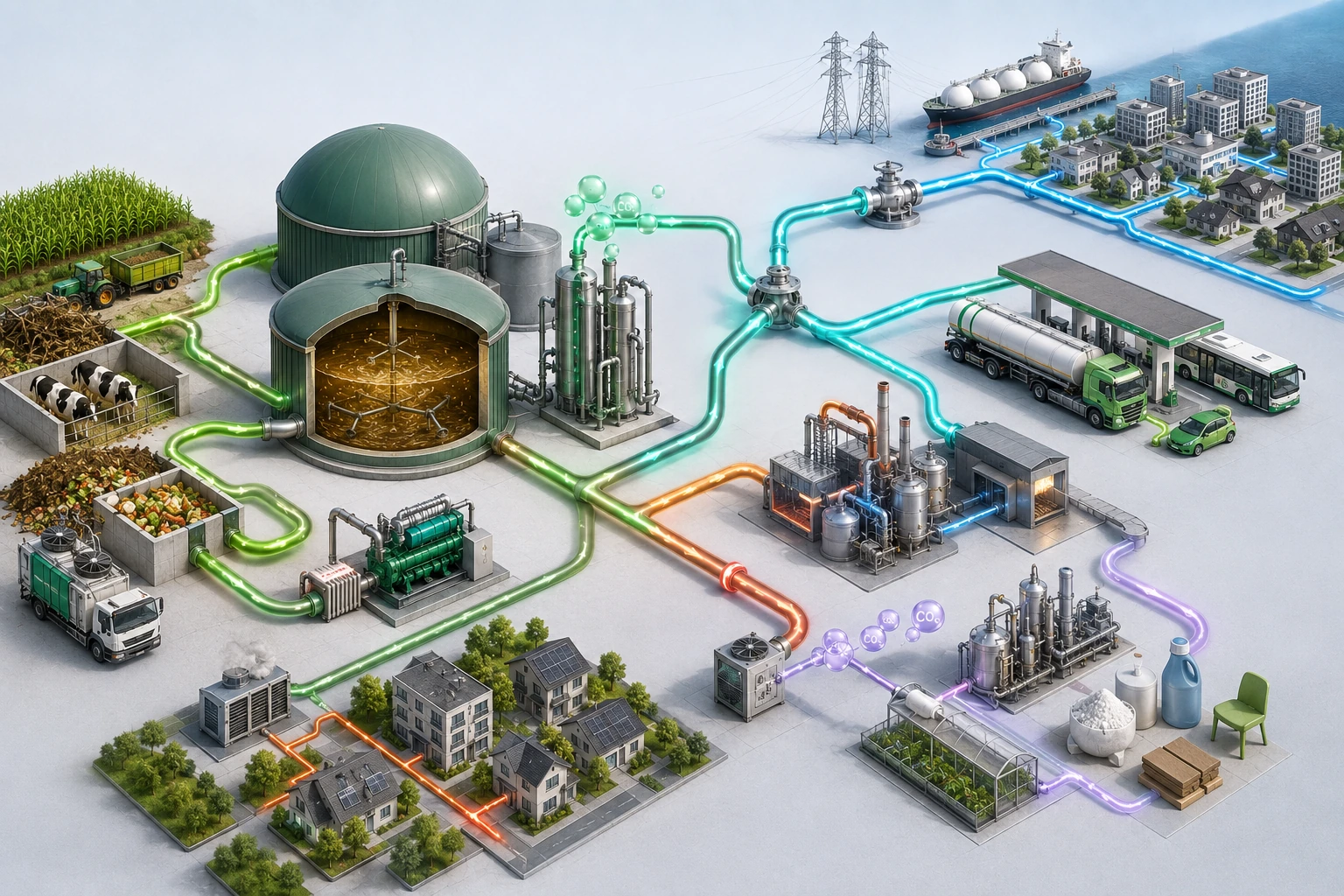
Choosing the gas market matters as much as choosing the upgrading technology. A cubic metre of biomethane can enter the public grid, a vehicle tank, an industrial burner or a process making another energy carrier. Each route requires different final treatment, infrastructure, contracts and metering.
Injection into the public gas grid
The grid permits continuous delivery and separates the production and consumption sites. Before connection, biomethane must meet specified quality, pressure and metering requirements. Projects typically include gas composition analysis, compression, fiscal metering, backflow protection and, where required by the operator, odorisation.
The main advantage is access to many consumers and the gas system's existing storage capacity. Constraints may include distance to the connection point, available grid capacity and the cost of equipment that must operate reliably as production varies.
Bio-CNG and Bio-LNG for transport
Biomethane can be compressed as Bio-CNG or liquefied as Bio-LNG. Compressed gas suits vehicles with CNG tanks and regional distribution. Liquefaction substantially increases volumetric energy density and may suit heavy road transport, vessels and sites far from the gas grid.
The distinction matters: the gas compressed or liquefied is sufficiently treated biomethane, not raw digester gas. LNG production requires very low temperatures, deep drying and strict control of CO₂ and other components that could freeze during the process.
Industrial heat and process gas
An industrial user can burn biomethane in a boiler, furnace, dryer or another high-temperature process. This may be particularly useful where direct electrification is technically difficult. Supply can be arranged through the grid or a local Bio-CNG or Bio-LNG chain.
A direct supply agreement should compare annual gas production with the customer's daily and seasonal process demand. An attractive gas price is insufficient without backup supply, storage or a reliable logistics plan.
Electricity when the system needs it most
Biomethane can fuel gas engines, turbines and fuel cells. Unlike electricity generated immediately from raw biogas at the digester, treated gas can be transported and stored temporarily. This allows flexible power generation when demand is high or solar and wind output is low.
This model makes sense only if the value of flexibility covers treatment, distribution and reconversion costs and losses.
Feedstock for hydrogen, methanol and other products
Renewable methane can be reformed to hydrogen or synthesis gas and then converted to methanol and other chemicals. The process route is established for natural gas, but its environmental and commercial value depends on the origin of the energy used, CO₂ management and rules for verifying renewable content.
For smaller biogas projects, this chain is usually more complex than grid injection or local gas use. It may be relevant in industrial clusters with shared infrastructure, continuous demand and uses for by-products.
Biogenic CO₂ is more than a waste stream
Upgrading biogas separates a stream rich in biogenic carbon dioxide. After further cleaning and liquefaction, it can serve certain industrial applications. Another option is methanation: reacting the separated CO₂ with renewable hydrogen to produce additional synthetic methane.
Both options require consistent quality, a market and additional energy. They should not automatically be counted as revenue, but merit consideration before the entire CO₂ stream is designed for release.
How should the route be chosen?
An initial assessment should compare gas volume and seasonality, distance to the grid and large users, electricity price, available heat, vehicle logistics, compression or liquefaction costs and the potential market for biogenic CO₂. Contractual risk and customer reliability over the plant's lifetime are equally important.
Sources and further reading
- European Commission – 5 things you should know about biogas and biomethane
- U.S. Alternative Fuels Data Center – Renewable Natural Gas Production
- IEA Bioenergy Task 37 – Circular economy approaches to integration of anaerobic digestion with Power-to-X technologies
This article is for information and does not replace technical, legal, market or financial analysis of a specific project. Gas quality and connection requirements depend on the operator, location and applicable regulations. The illustration shows possible uses, not a detailed engineering design.