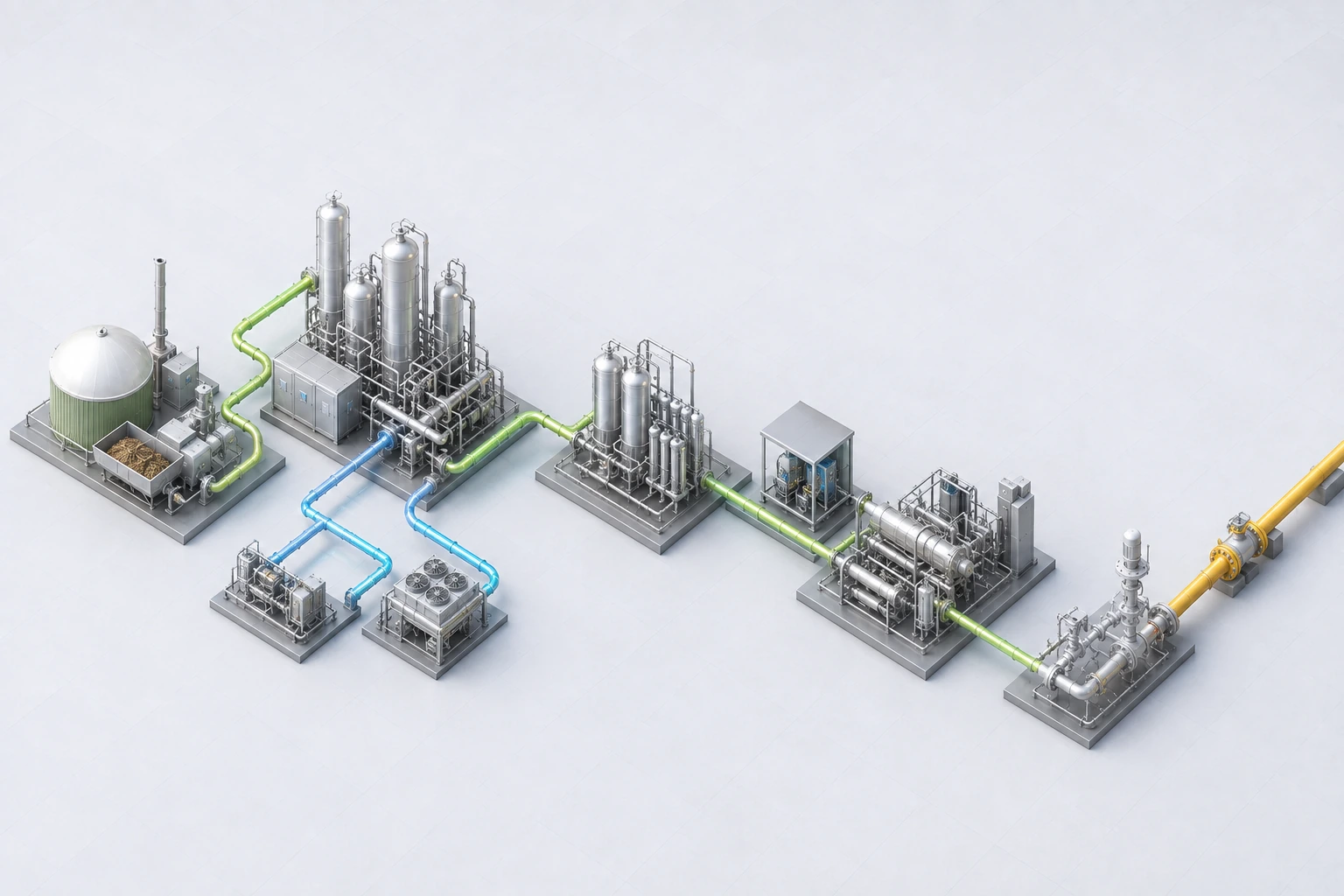
Biogas upgrading removes most carbon dioxide and contaminants, but biomethane is suitable for injection only when it meets the particular operator's rules. Requirements vary by country and network, so the technical concept should be agreed with the operator before the upgrading technology is finally selected.
Quality means more than methane concentration
The operator will generally consider calorific value or Wobbe index, moisture and dew points, oxygen, carbon dioxide, sulphur compounds and other constituents affecting safety, corrosion or appliance operation. Limits and sampling methods must be clear in the agreement.
Raw biogas composition changes with digester feeding and operation. Final treatment must therefore maintain specification under realistic variations, not just at its rated operating point.
Continuous analysis and automatic rejection of off-spec gas
An analyser monitors key parameters before delivery. If the gas falls outside the permitted range, valves automatically divert it back to the process, into storage or to a flare. Off-spec gas must not continue into the public network.
Pressure and available grid capacity
A compressor raises biomethane pressure above that at the connection point. Its required power depends on inlet pressure, target pressure and flow. Even a suitable compressor cannot guarantee delivery: the local network must be able to accept the gas year-round, including periods of low demand.
Without reverse flow to a higher-pressure network, summer demand in a small distribution area may constrain the project. Capacity analysis and measurements are therefore needed before investment; the mere presence of a pipeline beside the site is insufficient.
Volume and energy metering
Settlement is not based on volume alone. The metering system records flow, pressure and temperature, while composition determines energy content. Meters must meet applicable metrological requirements, be accessible for verification and support reliable data exchange with the operator.
Odorisation, backflow and safety
Depending on the delivery point, biomethane is odorised before entering the distribution network or within the operator's system. The connection station includes shut-off and non-return valves, overpressure protection, gas detection, ventilation and a safe vent. The division of responsibility between producer and operator must be precisely defined.
Certificates and physical gas flow are distinct
Once in the integrated network, biomethane mixes with other gas. Its renewable origin is accounted for through certification and volume records. The project must therefore also address feedstock sustainability, greenhouse-gas accounting and rules preventing double counting.
What to agree before ordering equipment
- exact gas specification and official metering point
- permitted flow and pressure throughout the year
- ownership, maintenance and verification of the connection station
- handling of off-spec gas
- data exchange, contractual settlement and sustainability evidence
Sources and further reading
- European Commission – Biomethane
- EUR-Lex – Directive (EU) 2024/1788 on the internal gas market
- European Commission – Union Database for renewable fuels
This article is for information and gives no universal limit values. The relevant operator and qualified designers must confirm technical, contractual, metrological and regulatory requirements for the particular location. The illustration is not a detailed engineering diagram.