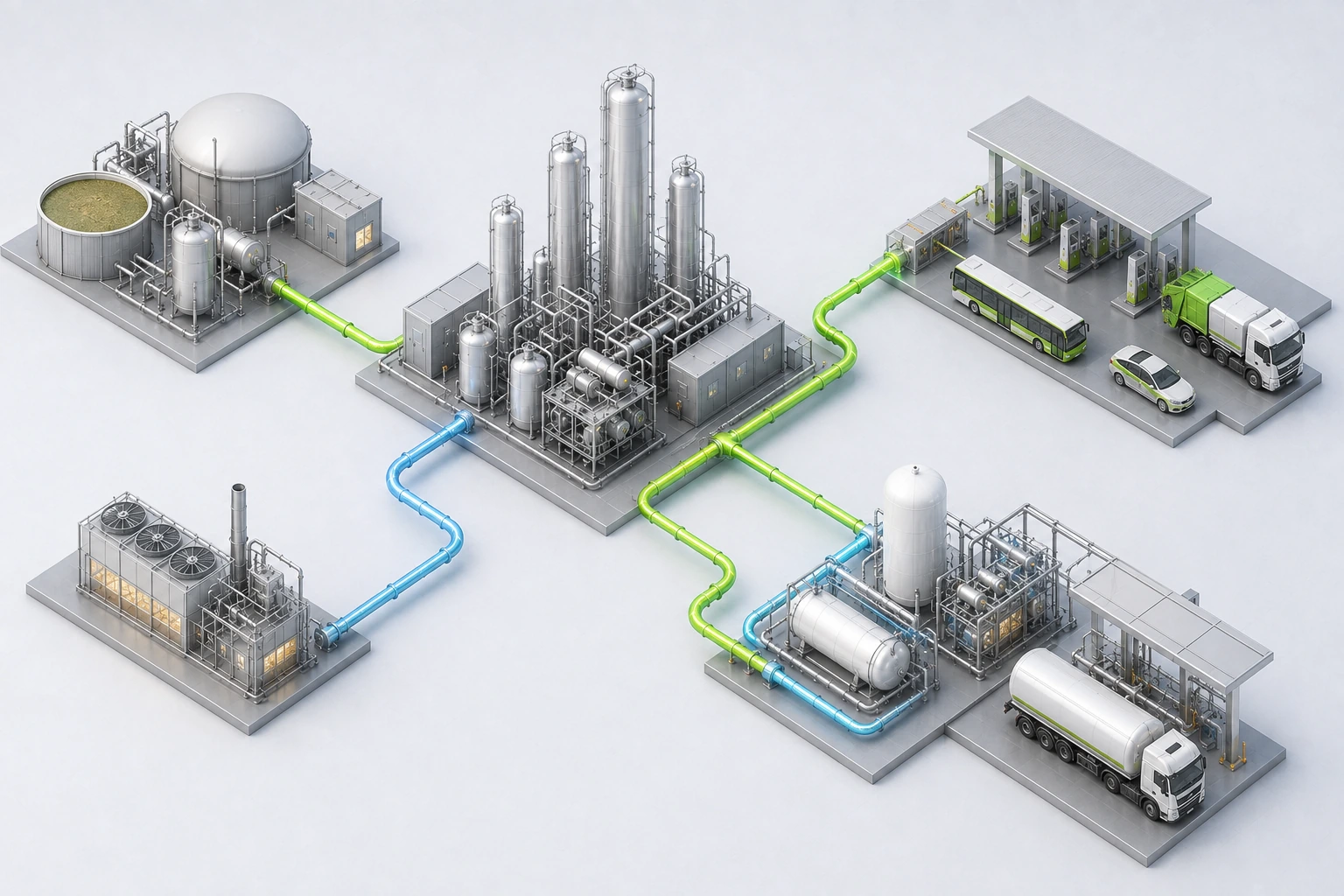
The first constraint is clear: vehicles do not use raw biogas from the digester. For transport, the gas is upgraded to biomethane quality, dried and conditioned, then compressed or liquefied. These final stages determine tank design, the filling station, energy consumption and vehicle range.
Bio-CNG: gas under high pressure
Bio-CNG is produced by multistage compression of biomethane. A filling station can use a cascade of storage vessels for fast filling or refuel vehicles more slowly while they are parked. This approach suits city buses, municipal and delivery vehicles, and fleets that regularly return to a depot.
Advantages include established CNG equipment and a less energy-intensive process than liquefaction. Because of its higher volumetric energy density, Bio-LNG can store more energy within the same tank volume, making it better suited to applications requiring longer range.
Bio-LNG: methane in a cryogenic tank
Biomethane is thoroughly dried and cooled to around its boiling point, turning it into a liquid and greatly reducing its volume. Bio-LNG allows more energy to be stored in a tank, making it relevant to heavy trucks, long routes, vessels and gas delivery to locations without pipelines.
Liquefaction requires a more complex cryogenic process, insulated tanks and management of boil-off gas. The gas must not contain components that could freeze at low temperatures and block the heat exchangers.
Vehicle dwell time affects the choice
A fleet parked overnight at its own depot can use slow CNG filling with a lower peak compressor capacity. A public heavy-truck corridor requires fast filling, high daily throughput and reliable fuel supply. Bio-LNG offers greater logistical flexibility, but must be kept at cryogenic temperature.
On-site production or supply via the gas grid?
A filling station can be connected directly to a local biogas upgrading plant or use biomethane sourced through the gas grid with an appropriate certification system. A local system reduces some transport needs, but must match continuous production with variable vehicle arrivals. The grid provides a larger buffer and more flexibility in station location.
Methane slip and actual climate impact
Biomethane can substantially reduce life-cycle emissions compared with fossil fuels, particularly when produced from waste and manure. The result nevertheless depends on methane losses in the digester, upgrading plant, compression equipment, filling station and vehicle. Even small leaks of this potent greenhouse gas can reduce the project's benefit, so leak-tightness must be measured and maintained.
How should CNG and LNG be compared?
- vehicle type, daily mileage and available tank space
- whether the fleet returns to base or operates on long-distance corridors
- daily fuel volume and the station's ability to operate continuously
- cost of compression versus liquefaction and cryogenic logistics
- availability of servicing, spare vehicles and a long-term fuel buyer
Sources and further reading
- U.S. Alternative Fuels Data Center – Renewable Natural Gas Production
- U.S. Alternative Fuels Data Center – Natural Gas Fuel Basics
- U.S. Alternative Fuels Data Center – Natural Gas Vehicle Emissions
This article is for information only. Pressures, cryogenic temperatures, fuel quality requirements, filling equipment, safety distances and economics must be determined for the specific project and applicable rules. The illustration is not a construction schematic.