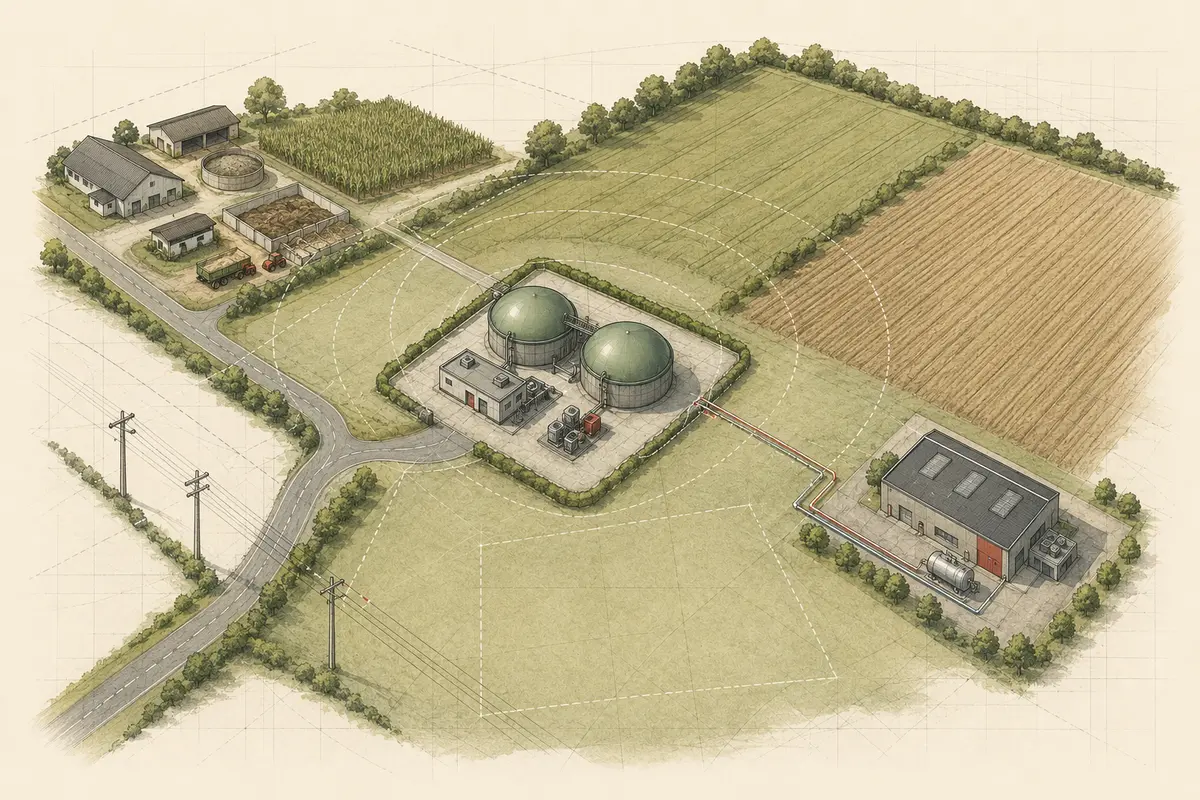
Choosing the site and size is one of the most important early decisions. A poor capacity choice is difficult to correct later: an undersized plant cannot use the available material streams, while an oversized plant continually needs additional feedstock and capital.
Feedstock sets the starting point
The assessment should list monthly quantities of each feedstock, distances, transport methods, storage options and material quality. A seasonal peak is not enough to size a plant that must operate year-round. Base, downside and growth scenarios for supply are useful.
What must a suitable site provide?
- safe access for trucks and agricultural machinery without unnecessary traffic through a settlement
- enough space for tanks, maintenance areas, fire-service access and possible expansion
- a reasonable distance from feedstock sources and land where digestate is used
- a realistic connection to the electricity or gas grid
- a heat user if CHP is planned
- suitable geotechnical, water, environmental and land-use planning conditions
Capacity must be balanced across the plant
Engine output or biomethane volume is only the end result. The capacities of reception, pumps, digesters, gas storage, gas treatment, digestate storage and grid connection must be coordinated. A bottleneck in one area can limit the whole plant.
At an early stage, it is useful to prepare a conceptual layout, mass and energy balances, a transport estimate, and a list of permits and connection conditions. Only then can several options be compared on the same basis.
Sources and further reading
- T. Al Seadi et al., Priručnik za bioplin, BiG>East, 2008.
- U.S. EPA – 10 Keys to Digester Success
- U.S. EPA – Types of Anaerobic Digesters
This article is for information only. It does not replace design work, a professional assessment, or legal, environmental or financial advice for a specific project.