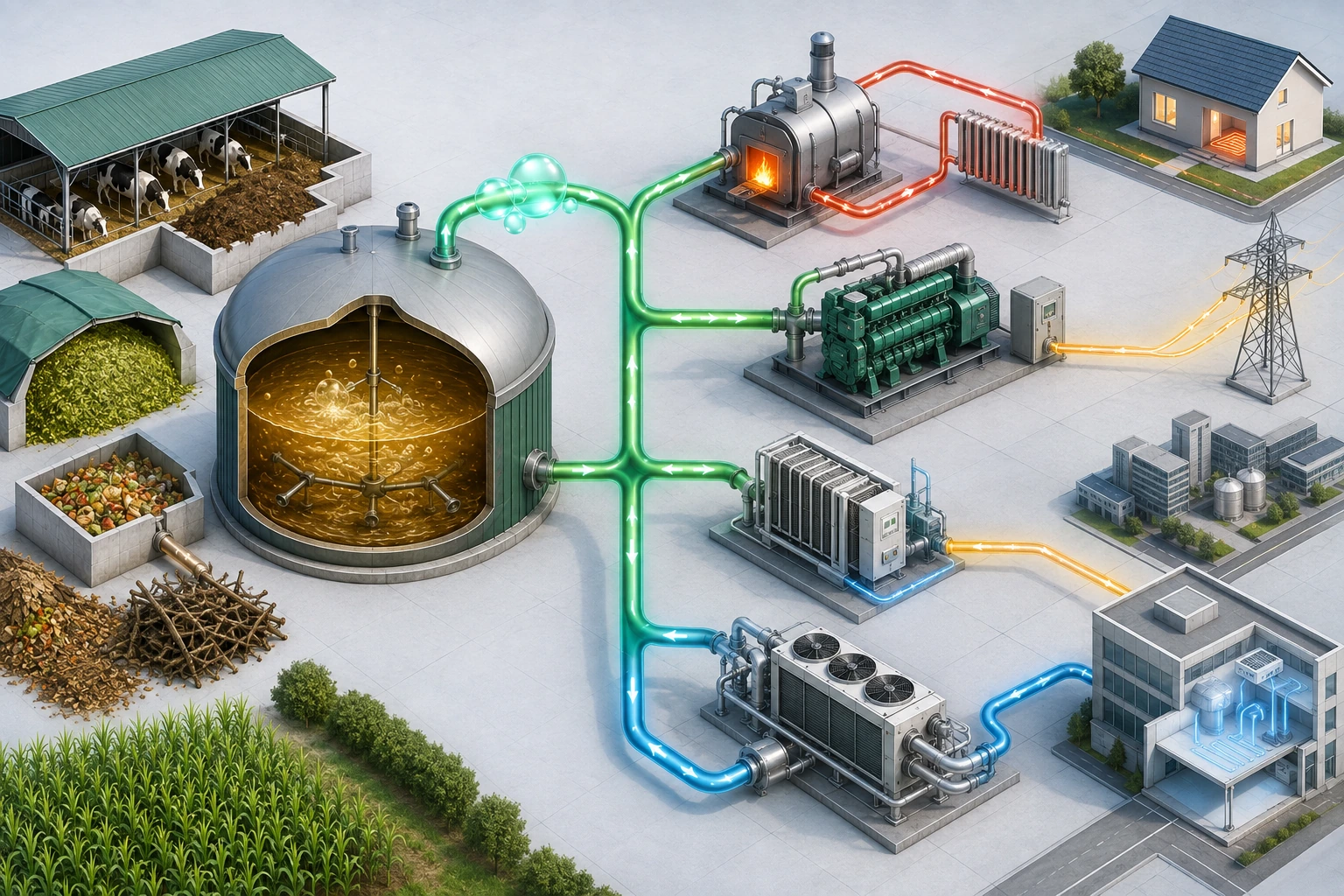
The choice of gas use affects almost the entire plant: gas-treatment requirements, storage, connections, auxiliary energy use and revenue model. Selection therefore concerns the full chain from gas production to the final energy customer, not just one machine.
The shortest route: direct heat production
After condensate, particles and hydrogen sulphide have been removed, biogas can be burned in a suitably adapted boiler, burner or dryer. The heat can warm digesters and buildings, produce hot water, dry materials or generate steam. Equipment is generally simpler than a power-generation system, but the project needs sufficiently large and steady heat demand.
CHP: electricity and useful heat
The best-known route is a gas engine driving a generator. Electricity is used on site or exported to the grid; heat from engine cooling and exhaust gas supplies the digester or another user. High overall utilisation is possible only if the heat is actually used. A cooler rejecting it to the environment generates no revenue.
Gas turbines and microturbines
A turbine compresses air, burns treated gas and uses expansion of the hot gases to drive a generator. Larger gas turbines suit larger, steadier fuel flows, while microturbines are offered as smaller modular units. Exhaust heat may be valuable for steam, process heating or drying, but fuel-gas compression and inlet-gas quality requirements must be included in the energy balance.
Fuel cells: electrochemical conversion
Fuel cells convert the gas's chemical energy to electricity without a conventional engine or turbine. They can offer high electrical efficiency, low vibration and low local emissions, but are sensitive to contaminants. Basic biogas treatment alone is insufficient: fuel preparation, reforming and the maintenance concept form one integrated system.
Trigeneration: when cooling has a genuine use
Where a site needs electricity, heat and chilled water, some CHP waste heat can drive an absorption chiller. This form of trigeneration can improve summer heat utilisation, for example in food processing or storage, but cooling is not free: the heat source must be at the right temperature, a cooling tower is needed and the system needs sufficient operating hours.
Upgrading to biomethane
Removing most carbon dioxide and contaminants produces biomethane, a gas similar to natural gas. Production can then be separated from use: the gas may be injected into the grid, compressed as Bio-CNG, liquefied as Bio-LNG or supplied to an industrial customer. This broadens the market but adds gas-treatment, compression, metering and quality-verification equipment.
What determines the choice?
- annual gas volume, pressure and variability of biogas composition
- value of electricity, heat and cooling at the particular site
- distance to the gas grid, industrial customer or filling station
- required treatment level and auxiliary energy use of the selected process
- service support, plant availability and contractual risk associated with the customer
The best solution is not necessarily the one with the highest nameplate efficiency. It is the process chain that reliably converts actual gas production into a product with steady demand throughout the year.
Sources and further reading
- U.S. EPA – Biogas Opportunities Roadmap
- U.S. EPA – CHP Technologies
- European Commission – 5 things you should know about biogas and biomethane
This article is for information. Actual selection requires analysis of the gas, energy demand, connections, applicable regulations and manufacturer proposals. The illustration shows possible functional routes, not a detailed engineering design.