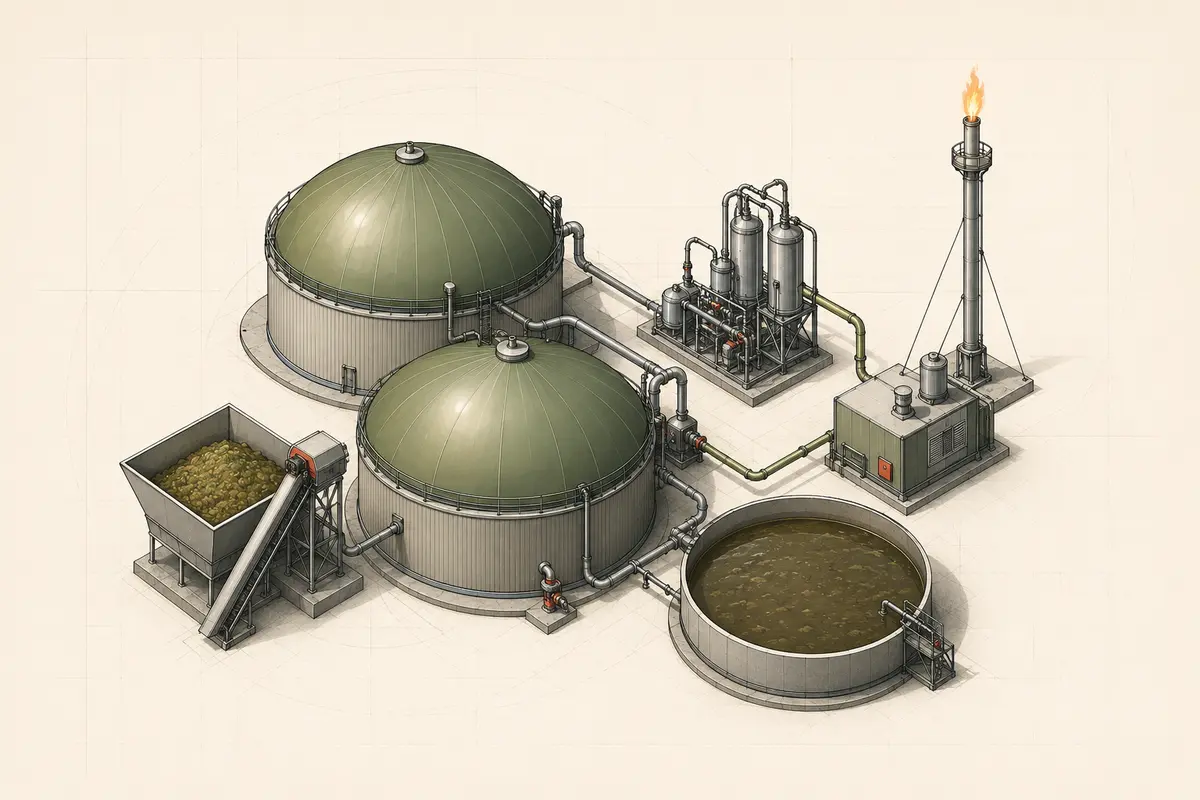
A biogas plant is not a single structure, but a set of interconnected civil, mechanical, electrical and process systems. Their layout depends on the feedstocks, capacity, energy use, site and environmental requirements.
Feedstock reception and preparation
Incoming material may be liquid, solid or pasty. Reception facilities may therefore include pits, tanks, silos, feeding equipment, weighbridges, contaminant separation, size reduction and homogenisation. Well-designed reception reduces stoppages and makes it easier to control what enters the process.
Digesters and mixing
A digester is an enclosed, thermally insulated vessel in which anaerobic digestion takes place. It is equipped with heating, agitators, pipework and instrumentation. Some plants have primary and secondary digesters; others use different configurations depending on dry matter content and process operation.
Gas and energy systems
The gas produced is held temporarily in a gas holder. It then passes through moisture condensation and the necessary treatment before reaching a CHP unit or a biomethane upgrading system. A safety flare allows surplus gas to be burned in a controlled manner when the main user cannot take it.
Digestate, controls and safety
After digestion, the material goes to final storage and may be separated into solid and liquid fractions. Plant controls monitor temperature, pressure, levels, gas composition and equipment operation. Gas detection, ventilation, fire protection and clearly defined access zones are integral to the design.
Sources and further reading
- T. Al Seadi et al., Priručnik za bioplin, BiG>East, 2008.
- U.S. EPA – Types of Anaerobic Digesters
This article is for information only. It does not replace design work, a professional assessment, or legal, environmental or financial advice for a specific project.