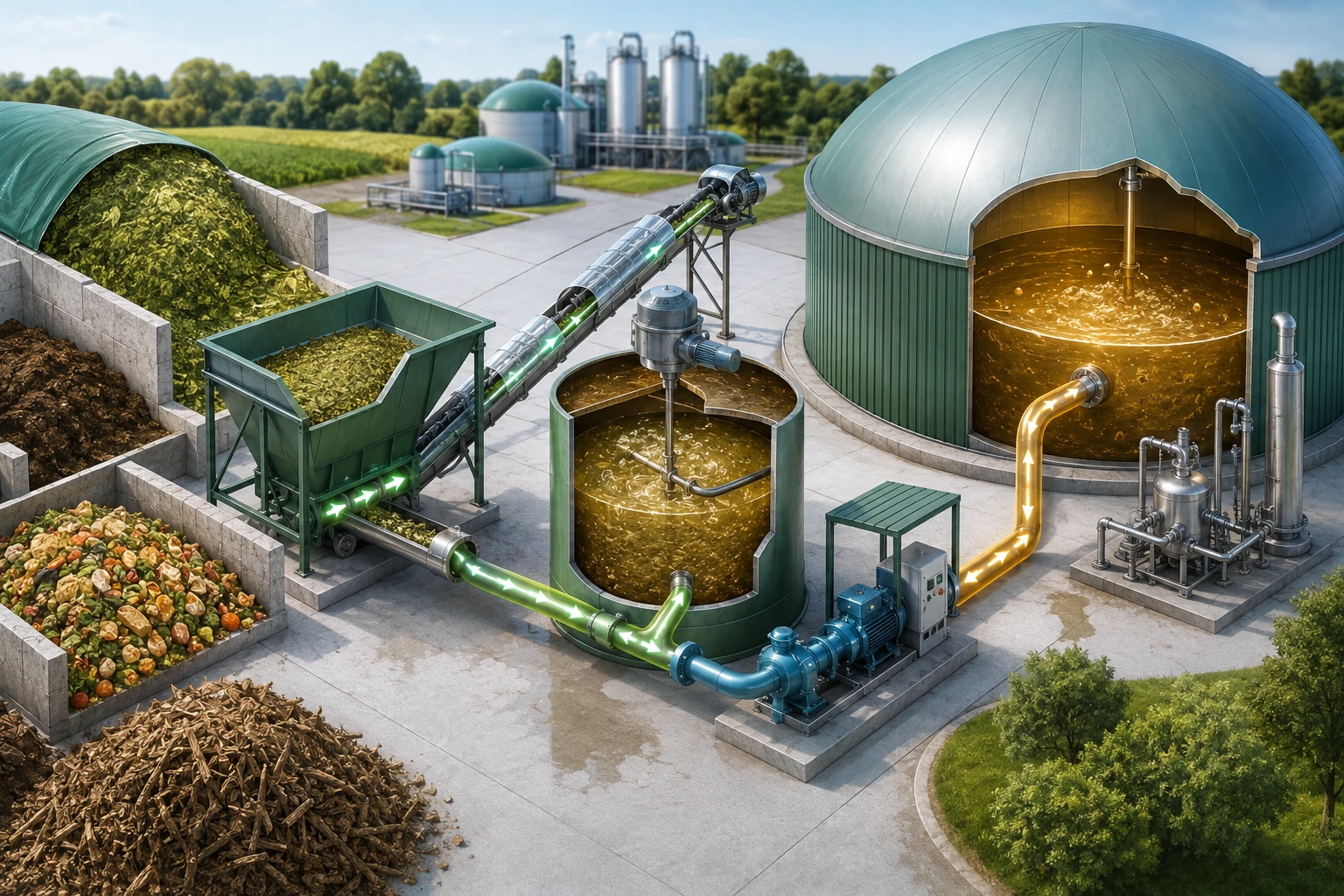
Solid feedstocks such as silage, farmyard manure, straw and organic residues differ in bulk density, fibre length, moisture and tendency to bridge. Equipment that works well with short-cut maize silage may perform differently with long-fibre or heterogeneous material. Selection begins with the actual feedstock mix rather than the rated tank volume.
What does a feeding system need to do?
The system's basic task is to meter out a controlled quantity of material and transfer it to the next processing stage. That might be a screw conveyor, mill or other size-reduction equipment, a pump with recirculated liquid or a direct digester inlet. It must prevent blockages, overloads and large swings in process loading. Scales and automation help make feed batches repeatable, but cannot compensate for poor substrate flow or an unsuitable mechanical design.
Five specific approaches
Huning's modular systems range from a smaller rotary RDS feeder to moving-floor tanks. They can be integrated with different screw conveyors and preparation equipment. This approach suits projects in which storage, discharge and further processing are configured as separate, adaptable stages.
Trioliet Solomix uses a stationary vertical mixer. The manufacturer lists configurations with one, two or three vertical augers and capacities of 10 to 80 m³. Mixing before discharge can help when several solid ingredients need to be combined before further transport.
BioG BioFeeder was developed for long fibres and heterogeneous materials such as straw, farmyard manure and catch crops. According to the manufacturer, coordinated drive controls and OPTIFEED regulation reduce blockages and bridging. Available capacities from 12 to 240 m³ show the basic concept at very different scales.
Vogelsang PreMix is a wet-feeding approach. Solid material is mixed with liquid to form a pumpable organic suspension; heavy foreign objects are separated, fibres are cut and the prepared mixture is pumped to one or more digesters. This compact integration may suit projects needing a homogenised, pumpable mixture, but requires well-designed recirculation and maintenance arrangements.
Börger Powerfeed also introduces biomass into a recirculation stream, but by a different mechanical route. Material supplied by a screw is compacted in a channel to form a plug, then enters an enclosed pipeline in a controlled manner. The manufacturer states that one unit can serve several tanks at different elevations. This solution must be assessed together with the pump, pipelines and available recirculated liquid, rather than as a standalone bunker.
Dry or wet feeding?
With dry feeding, material is conveyed mechanically to the digester or a preparation stage. The arrangement is often straightforward, but screws, openings and transitions must be sized for the most demanding feedstock. Wet feeding mixes solids with liquid before pumping, which may provide a more even flow but makes pump protection, foreign-object removal, wear and the system's hydraulics more important.
How should the choice be made?
Compare options against the same basis: daily mass and volume of each feedstock, maximum expected fibre length, dry matter content, possible stone or metal contamination, required loading frequency, space and loader access. Electricity consumption, availability of critical spares, cleaning time and maintenance without lengthy plant shutdowns are equally important.
Sources and further reading
- Huning – solid feeding systems for biogas plants
- Trioliet – stationary feed mixers for biogas
- BioG – BioFeeder feeding technology
- Vogelsang – PreMix solid matter feeder
- Börger – Powerfeed solid-feed technology
- T. Al Seadi et al., Priručnik za bioplin, BiG>East, 2008.
The capacities and capabilities described are based on manufacturer information. This article is for information; it is neither a product ranking nor a recommendation of a particular product, and it does not replace project-specific analysis.