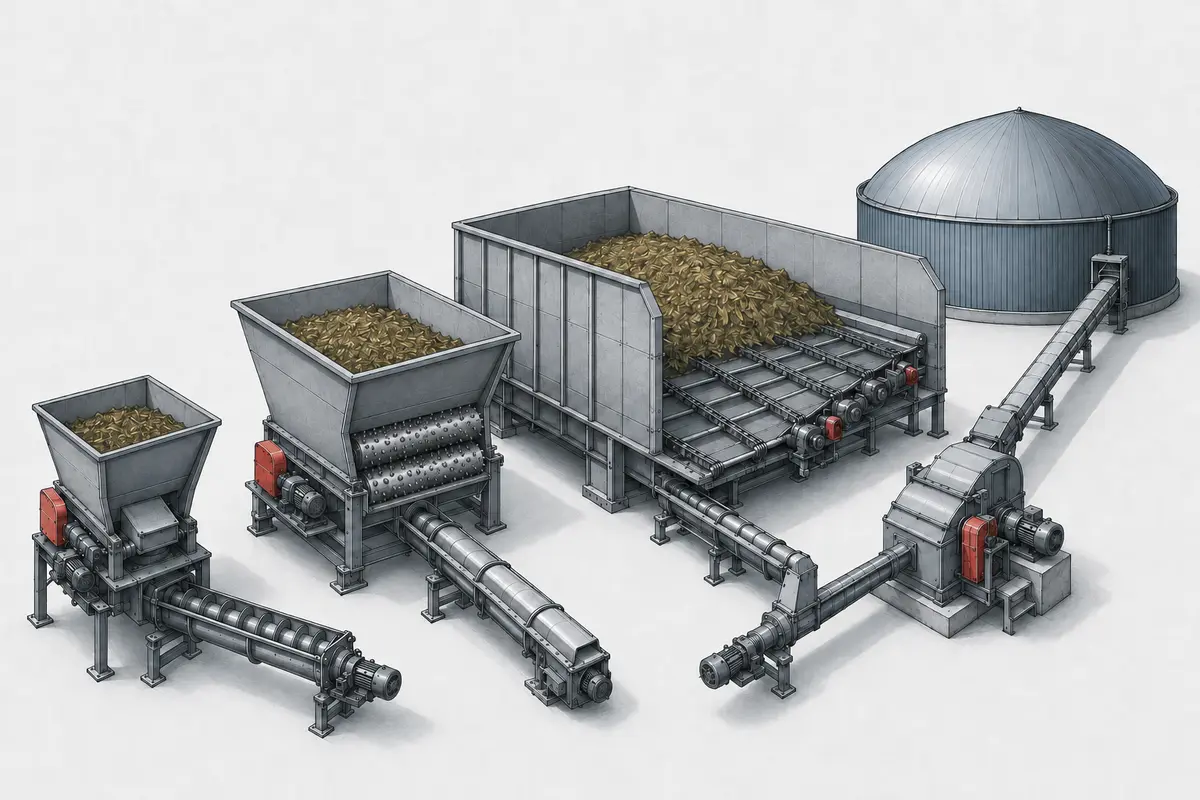
Huning builds its solid-feedstock systems from standardised, interconnectable components. This modularity allows the feed tank to be combined with screw conveying, weighing and, if needed, size-reduction equipment. Designers and operators therefore need to select the entire material path from loader to digester, rather than one machine.
RDS 7–12 m³: small and straightforward
RDS is a rotary feeding system with a base capacity of 7 m³, extendable to 12 m³ according to the manufacturer. A rotor discharges material towards a side opening. Huning positions it for smaller biogas plants, approximately up to 150 kW, and emphasises its straightforward, robust construction.
This configuration suits moderate daily quantities where the loader can refill the tank more frequently. A smaller tank occupies less space but provides less reserve between fills. Loader bucket volume, daily feed mix, number of fills and unattended operating time should therefore be considered from the outset.
Compakt 15–35 m³: feeding with active loosening
Huning Compakt covers tanks from 15 to 35 m³. Two rollers with interchangeable tools in the discharge area loosen material and reduce bridging with poorly flowing substrates. The manufacturer uses stainless steel for product-contact surfaces, and optional weighing tracks the quantity discharged.
The medium-sized tank offers more than longer operation between fills than RDS. Its two rollers more actively prepare an uneven material layer for discharge, which can matter for mixtures with different structures. Discharge can feed directly, use an overhead screw conveyor or connect to a pump system. The best arrangement depends on level differences, available space and downstream preparation.
Moving floor 30–200 m³: substantial storage and controlled discharge
For larger quantities, Huning offers steel tanks with moving floors. The manufacturer lists volumes of 30 to 200 m³ and designs with a sliding frame or faster transport floor. The floor moves material to the outlet, where metering or opening rollers deliver it to the conveying system. The tank can be fitted with load cells for weighing.
A larger volume provides longer autonomy and may reduce loader visits. At the same time, the foundation, filling access, weather protection, maintenance space and safe access to hydraulics and rollers become more important. The design should also consider heavy or wet material standing in the tank for long periods: rated volume alone does not indicate how much can be discharged reliably.
Where does substrate preparation fit?
Each configuration may be only the first stage. According to Huning, RDS can be combined with screw conveying, Biocutter and Optimatic Hammer Mill equipment. The manufacturer lists modular Optimatic hammer mills of different power ratings, with throughput dependent on substrate. Preparation can shorten fibres and make material more uniform before further conveying, but adds energy use, wear and a need for foreign-object protection.
What to compare before selecting a system
Measure the daily mass and actual bulk volume of feedstocks first. Then check fibre length, dry matter content, tendency to cake and possible stones or metal. Only then select tank volume, discharge method, rollers, weighing and further conveying. Spare-part availability, replacement of wear components, safe access for clearing blockages and operation during maintenance of individual stages also deserve attention.
Sources and further reading
- Huning – RDS 7–12 m³
- Huning – Compakt system 15–35 m³
- Huning – push-floor container 30–200 m³
- Huning – Optimatic Hammer Mill
- T. Al Seadi et al., Priručnik za bioplin, BiG>East, 2008.
Technical ranges and capabilities are based on public manufacturer information and should be checked for the actual configuration. This material is for information and does not replace sizing, a manufacturer's quotation or professional project assessment.