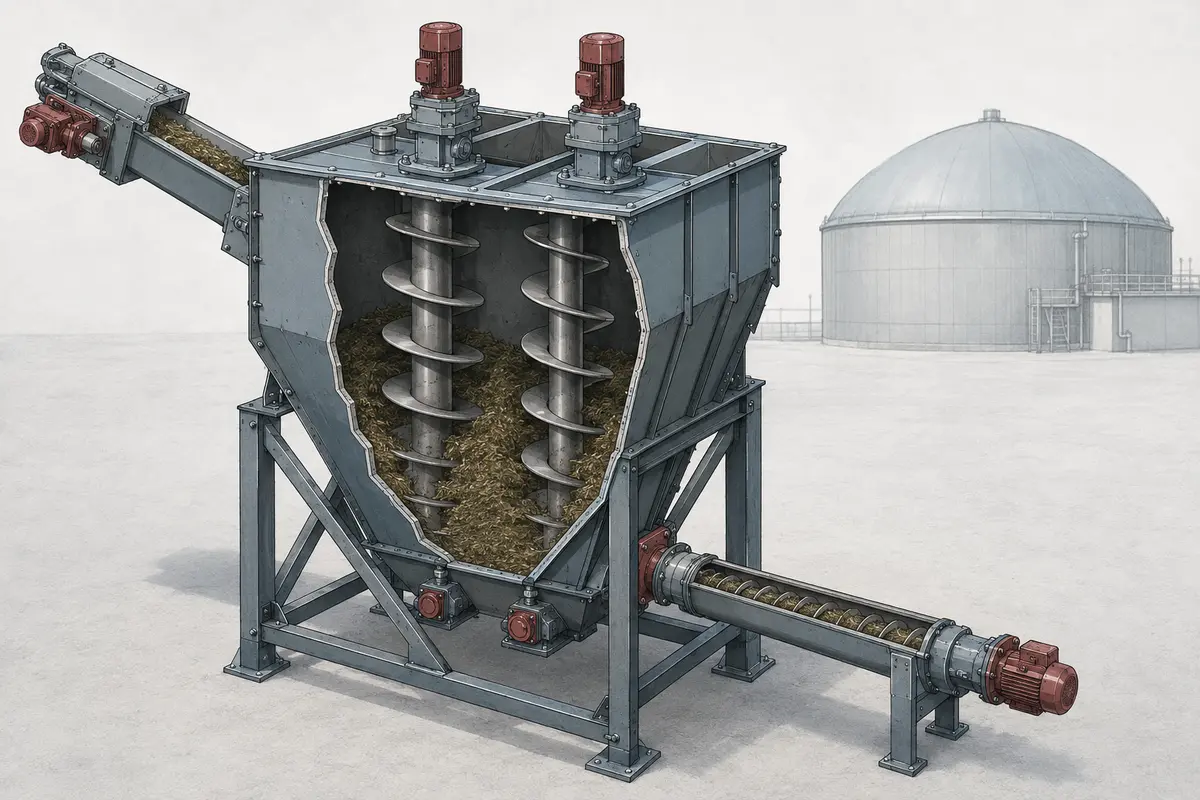
A stationary mixer does more than a basic intake bunker. It holds a quantity of material, actively mixes it and then discharges it to a screw, chain or other conveyor. This arrangement is useful when several solid components need to be mixed before entering the digester.
One concept, three size groups
For biogas plants, Trioliet offers Solomix 1, 2 and 3 STAT Biogas. According to the manufacturer's current information, Solomix 1 has one vertical auger and capacities of 10–18 m³. Solomix 2 has two augers and covers 12–40 m³, while the three-auger Solomix 3 covers 46–80 m³. The overall range therefore comprises machines of different lengths, drive arrangements and space requirements rather than one continuously scalable configuration.
Solomix 1 comes with one discharge opening, a motor-driven planetary gearbox, counter-knives and supports that can accommodate load cells. The manufacturer specifies one or two electric motors driving the two augers of Solomix 2; Solomix 3 has three separately mounted side motors with planetary gearboxes. These differences directly affect electrical installation, maintenance access and starting under load.
What does mixing before feeding achieve?
When different materials are loaded into the tank, vertical augers can reduce variation between individual loader bucket loads. The resulting mixture is not necessarily fully homogeneous, but discharge to the digester is more consistent than if each layer left separately. Mixing performance depends on fibre length, moisture, bulk density, fill level and loading sequence.
The manufacturer's specifications include knives on the augers and manually adjustable counter-knives. Their primary function is cutting and mixing inside the tank. They do not necessarily replace a separate size-reduction device when feedstocks contain very long fibres or foreign objects, or when downstream pumping equipment needs a tightly controlled particle size.
Sizing involves more than choosing a volume
Rated volume must be compared with the actual bulk volume of the daily feed batch. Selection requires knowing how often the operator fills the mixer, how long material stays in it and how much free space is needed for effective mixing. Overall machine height, loader access, motor positions and the discharge height to the next conveyor also matter.
The weighing method also needs to be defined in advance. Solomix can be mounted on supports with load cells, but feeding accuracy depends on the entire chain: correct loading, a stable base, calibration, discharge rate and control logic. The scales show changes in tank mass; they do not themselves prevent bridging, backflow or overloading the downstream auger.
Where does this system fit best?
Solomix is appropriate when active mixing is required and there is enough height and maintenance space for a vertical tank. A simpler bunker may suffice for a plant using one free-flowing feedstock. A mixer can help with solid mixtures of different densities, but its discharge must still match conveyor capacity and digester intake.
Sources and further reading
- Trioliet – Solomix 1 stationary feed mixer for Biogas
- Trioliet – Solomix 2 stationary feed mixer for Biogas
- Trioliet – Solomix 3 stationary feed mixer for Biogas
Capacities and equipment descriptions are based on public manufacturer information and must be verified for the particular configuration. The illustration shows a functional principle, not an exact factory configuration. This material is for information and does not replace sizing calculations or a manufacturer's quotation.