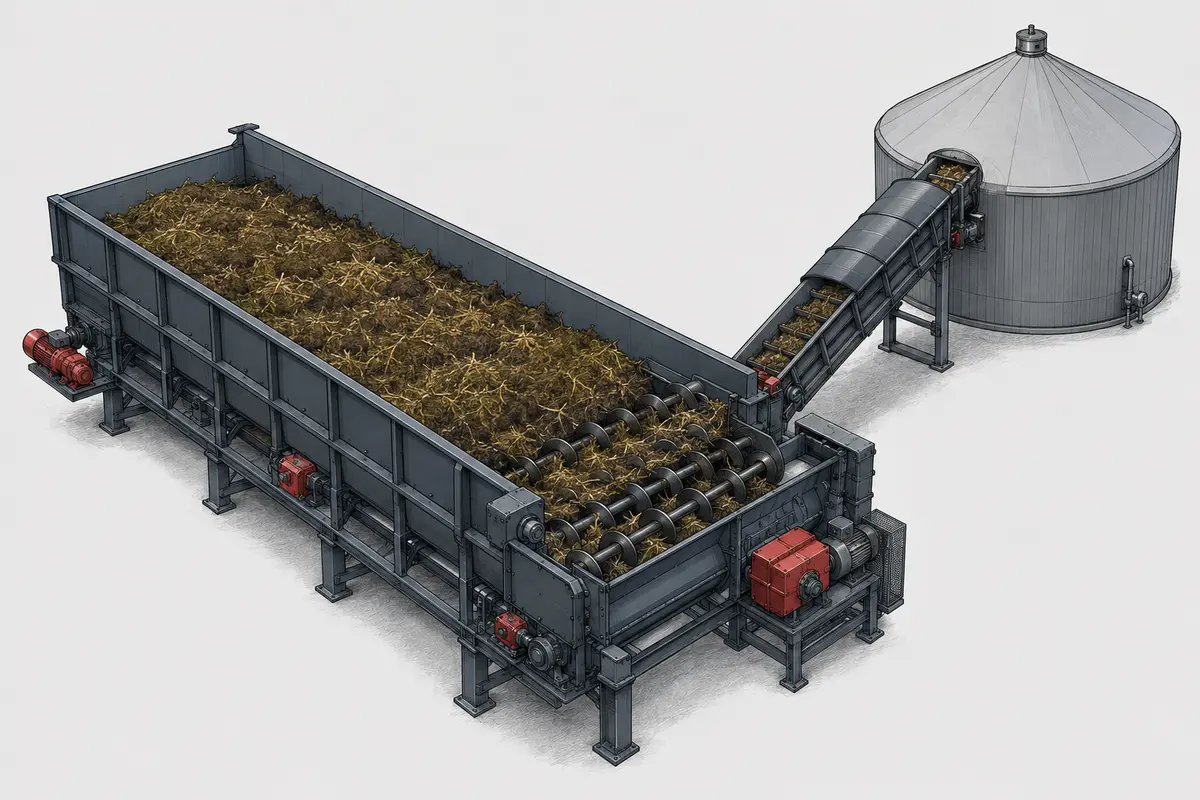
Straw, solid manure, catch crops and other biogenic residues do not flow like free-flowing granules. Fibres interlock, the mass can bridge across the hopper walls, and the conveyor beneath it is left without material. Increasing drive power alone raises the load on screws and transmissions but may not remove the cause of the blockage.
BioFeeder's primary function
BioG BioFeeder is a storage and feeding system that moves heterogeneous material towards the discharge zone. The manufacturer highlights coordinated conveyor drives and OPTIFEED control, which responds to changes in material structure. The aim is to reduce blockages and bridging as material passes to the next process stage.
The screw arrangement also mixes material in the immediate discharge zone. This matters when different feedstocks share a hopper: the outlet should not receive only light straw for a time and then suddenly a heavier, wetter material. BioG states that the system can continuously feed a fermenter, defibrator or pump system, depending on the plant configuration.
Reversing as part of process control
A notable feature is the ability to reverse material movement and operate in the opposite direction. Reversing is not only a way to clear a blockage: with properly coordinated controls it can relieve the discharge zone when an irregular load occurs. It cannot, however, compensate for an undersized outlet or a feedstock containing pieces the equipment cannot handle mechanically.
Materials and hopper size
BioG specifies corrosion-resistant stainless steel as standard for parts in contact with the feedstock and associated conveying components. Hopper walls may use multilayer panels coated with phenolic resin; polyethylene or stainless steel are listed as options. Material selection should reflect moisture, chemical exposure, abrasion and cleaning methods.
The product range includes several system sizes; the published overview gives a broad range of approximately 12–240 m³. A larger hopper provides more operating autonomy, but increases the foundation load and the quantity of material that may remain under its own weight for an extended period. Usable volume should therefore be checked against the heaviest and most demanding planned feedstock, not just the nominal geometric capacity.
What needs to be defined in the project?
In addition to daily quantities, the specification should state fibre length range, dry matter content, bulk density, manure share and possible foreign objects. The complete material path must be agreed: loading method, hopper discharge, position of the outlet conveyor and the capacity of the defibrator or pump. Controls must coordinate all drives so that a downstream stoppage does not overfill the discharge zone.
Maintenance access deserves as much attention as hopper volume. Motors, screws and potential blockage points must be safely accessible. Since fibrous materials are the reason for selecting this type of system, the offer should include a demonstration or a reference using a comparable feedstock.
Sources and further reading
The description of functions and materials is based on the manufacturer's public information and must be confirmed for the selected configuration. The illustration shows a functional principle, not an exact factory model. This article is for information only and does not replace technical sizing.