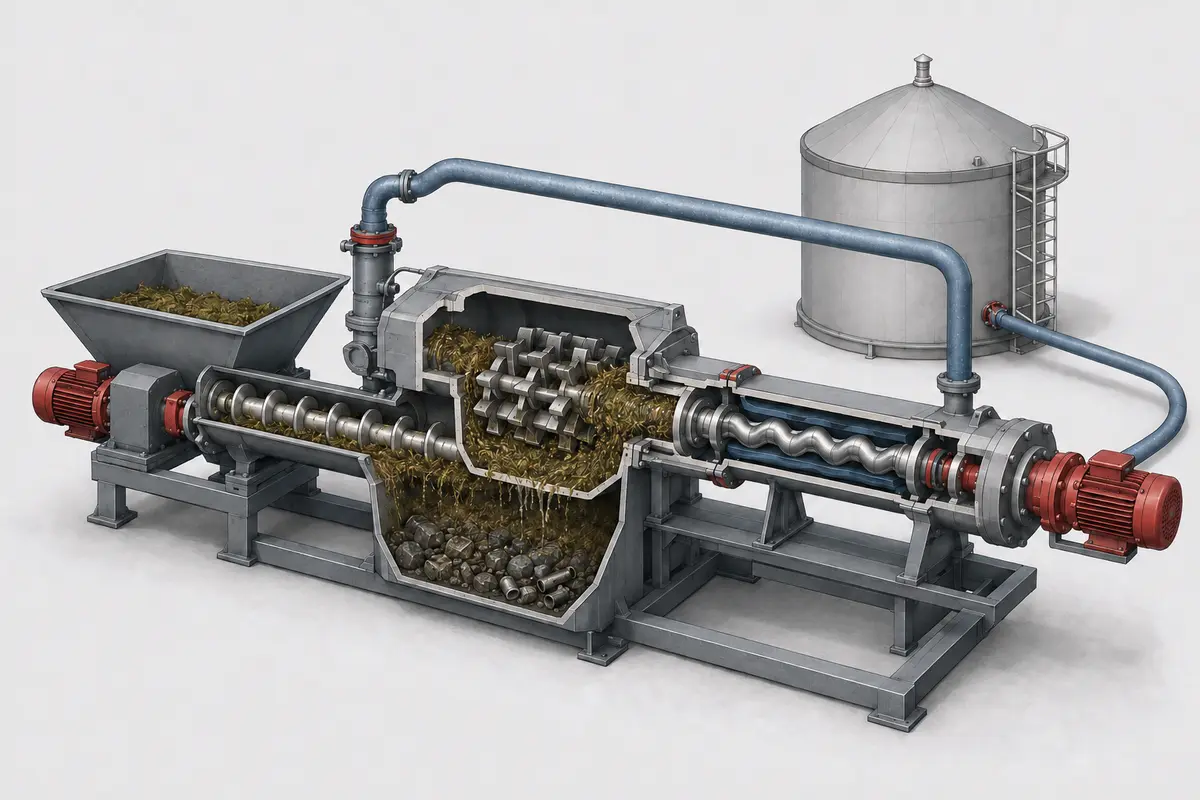
In wet feeding, solid biomass is mixed with liquid, usually recirculated digestate or slurry, before entering the digester. The resulting suspension can travel through a pipeline. This can simplify distribution to one or more digesters, but makes pump selection, protection from foreign objects and control of mixture density more important.
Four operations in one unit
Vogelsang describes PreMix as a combination of a CC-series progressive cavity pump and RotaCut RCX cutter. A side screw supplies solid or pasty material while liquid is added. Heavy objects are separated, biomass mixes with the liquid, coarse and fibrous particles are cut, and the pump sends the prepared suspension to the digester.
Sequence matters: heavy objects are separated and fibres cut before the more sensitive pump parts. This reduces the risk of stones, metal or long fibres reaching the pump. The manufacturer lists an optional Debris Removal System to discharge separated objects during operation and a Debris Lift Unit to lift them into a container.
RCX-58G and RCX-68G
The current range has two main models. The manufacturer positions RCX-58G as a compact standard unit for various biomass types, including organic waste, dry poultry manure, grass silage and food waste. RCX-68G is intended for larger plants and cases requiring more intensive preparation or higher throughput.
The model names alone do not establish throughput for a particular feedstock. Flow depends on dry matter content, fibre length, added liquid, pipeline pressure and required size reduction. The project specification should cover the full range of feed mixes and request a capacity figure for the most demanding expected mixture.
Distribution to several digesters
Because PreMix discharges a pumpable suspension, the manufacturer states that one unit can serve several digesters through a pipeline and valve network. This may reduce the number of separate feeding points. But the unit then becomes a shared point of failure, so the effects of downtime, bypass options and maintenance time need consideration.
Hydraulic calculations must cover the furthest tank, elevation differences, pressure losses and changes in suspension viscosity. The source and return point of recirculated liquid also need to be defined. Too much liquid increases pumping volume and may reduce useful digester capacity; too little can hamper mixing and transport.
Maintenance is part of the process concept
The cutter, cutting plates, blades, pump stator and rotor are wear parts. Vogelsang states that the pump and RotaCut can be serviced in place without dismantling inlet and outlet pipework. That benefit depends on sufficient space to open the casing, remove components, lift heavier parts and flush the system safely.
Controls must coordinate solid-feed supply, liquid flow, cutter load, pump speed and pipeline pressure. If any component reaches its limit, feeding must be reduced in time. The foreign-object separation system also needs monitoring and regular emptying; its presence does not remove the need to inspect incoming feedstock.
When does PreMix make sense?
A compact unit of this type is particularly relevant for feed mixes with fibrous or heterogeneous solids, where pumped feeding is preferred or one unit must serve several tanks. It is not automatically better than dry screw feeding: the decision depends on available recirculated liquid, existing pipelines, acceptable wear, spare capacity and service access.
Sources and further reading
- Vogelsang – PreMix: models and features
- Vogelsang – PreMix design and operating principle
- Vogelsang – dry and liquid feeding in biogas plants
The technical description and stated capabilities are based on the manufacturer's public information. Actual throughput, wear and energy use must be checked for the feedstocks and hydraulic network in question. The illustration shows a functional principle, not an exact factory model.