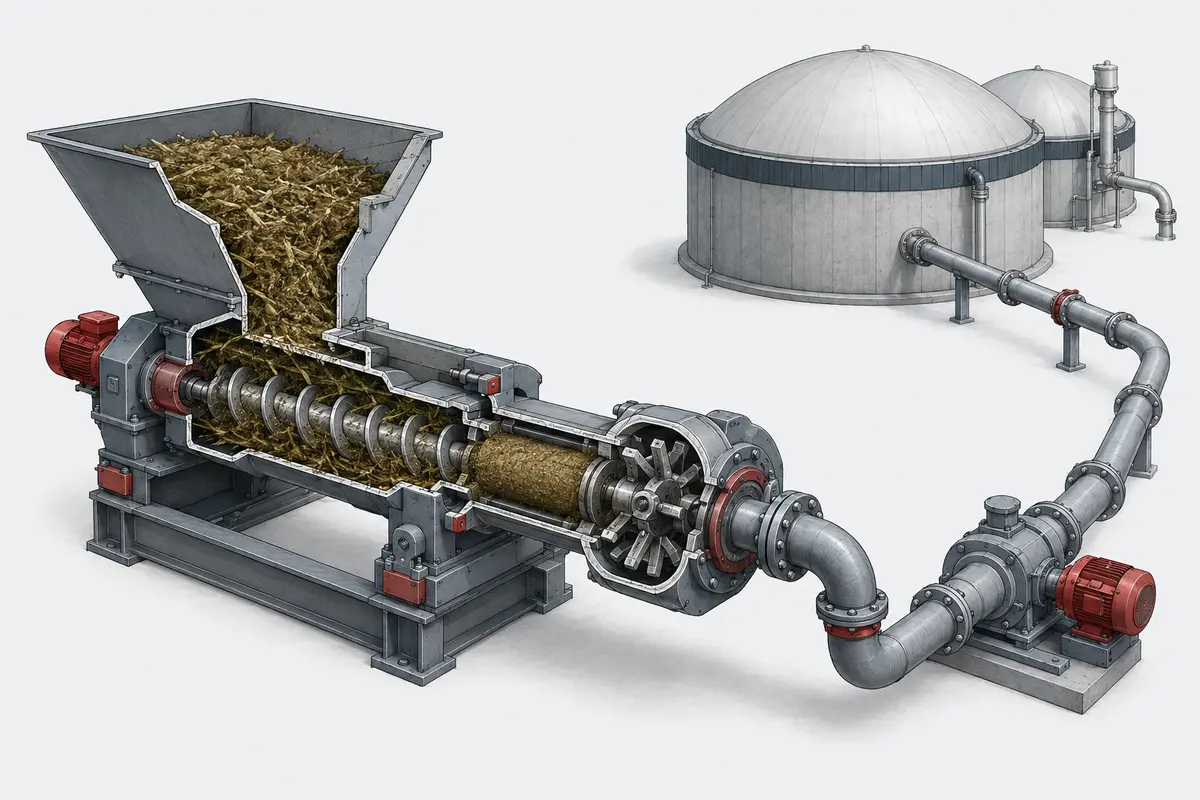
Börger Powerfeed is a wet-feeding system, but mechanically differs from systems that first prepare a mixture in an open chamber. Here, solid biomass is introduced directly and in a controlled manner into a pipeline carrying recirculated liquid. The manufacturer describes a fully enclosed arrangement in which one unit can serve several tanks at different elevations via a pump and valve network.
From feed screw to pipeline
Material enters Powerfeed through an opening supplied by the discharge screw of a mixing feeder or moving-floor tank. An internal screw moves biomass into a pressure channel, where it is compacted, trapped air is expelled and a dense plug forms a barrier between the feed side and the induction unit.
Rotating knives then remove particles from the plug, and mixing paddles introduce them into the recirculation stream. The enriched liquid is pumped to the selected digester. Powerfeed should therefore be considered a central assembly working with the upstream tank, feed screw, biogas-plant pump, pipeline, valves and control system.
Three feed arrangements
Powerfeed connect connects laterally to the discharge screw of an existing feed tank or moving floor. The manufacturer quotes 4–5 t/h for connect 300 and 7–9 t/h for connect 400. Powerfeed is loaded from above through its own intake hopper and has the same stated capacity ranges in sizes 300 and 400.
Powerfeed duo combines the unit with a stainless-steel tank. According to the manufacturer, the tank is 3 m wide, holds 10 t and has a paddle drum that loosens and evenly discharges solid material. The stated capacity of duo 400 is 7–9 t/h. These are the manufacturer's rated figures; actual performance must be confirmed for the biomass's bulk density, structure and dry matter content.
Why does plug formation matter?
The compacted plug reduces the air introduced with solid material and creates a mechanical barrier to the liquid side. The manufacturer associates the enclosed design with less odour and prevention of gas release. The design must still independently check pressure limits, backflow protection, interlocks and behaviour during a power failure.
Börger also states that smaller particles in the recirculation stream can reduce floating-layer formation and mixing demand. These are manufacturer claims; actual effects depend on the substrate, rheology of the digester contents, existing mixers and feeding regime. Without plant-specific data, they should not be treated as guaranteed energy savings or higher gas yield.
Controls and maintenance
The controls must coordinate Powerfeed, the recirculation pump and feed screw. The manufacturer specifies pressure monitoring, dry-run protection and function monitoring, as well as fieldbus integration. This is especially important when one unit feeds several tanks: the valve to the intended digester must be confirmed before solid feed is started.
A quick-release cover provides access to service parts, but the unit needs enough surrounding space for safe opening and work. The maintenance plan should cover the screw, pressure channel, knives, paddles, seals and recirculation pump. Procedures for emptying and isolating the pipeline before maintenance are also needed.
When does this concept fit?
Powerfeed is relevant where a plant needs enclosed feeding of solid biomass into recirculated liquid or one central unit serving several digesters. The connect version may suit an existing bunker or moving-floor system; duo includes an integrated storage tank. Before selection, check that sufficient recirculated liquid is available, the pump can overcome the total pressure and the plant can operate while the central unit is being serviced.
Sources and further reading
Capacities, design characteristics and claimed benefits are based on public manufacturer information and must be verified for the actual biomass and plant configuration. The illustration shows a functional principle, not an exact factory model.