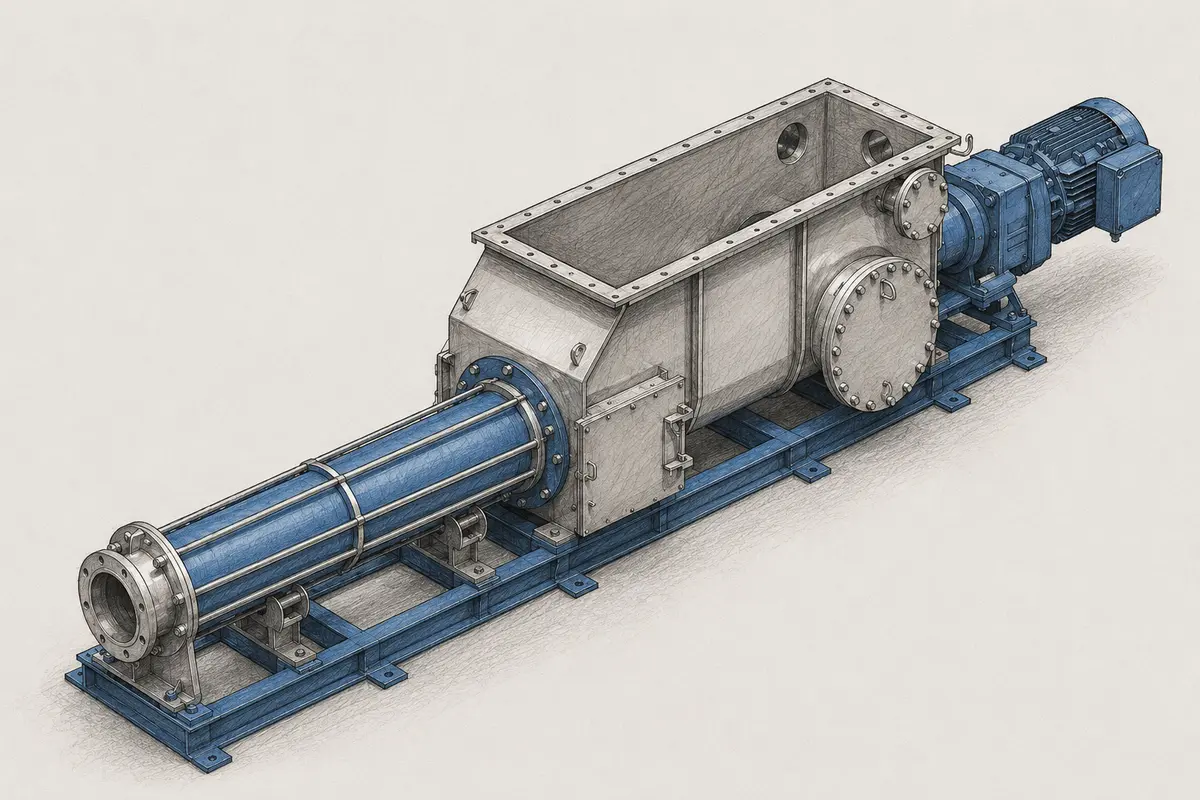
Wet feeding involves more than moving solid material. It must be mixed with recirculated liquid, slurry or another liquid phase to produce a mixture that can be pumped reliably through a pipeline. WANGEN BIO-MIX 200 uses an intake hopper, feed screw and progressive cavity pump for this purpose.
How does the system work?
Solid feedstock enters an extended intake chamber. Liquid can be added through connections on both sides, and the manufacturer states that the entire hopper serves as a mixing zone. The feed screw moves the prepared material towards the pump chamber, where the rotor and stator generate continuous pressure for transport.
This arrangement allows one unit to mix and transfer maize or grass silage, manure, straw and other fibrous components. However, claims that it handles all biogas substrates need to be assessed against the actual configuration, upstream preparation, dry matter content and permitted size of foreign objects.
Capacity and configurations
According to the manufacturer, rated flow reaches 150 m³/h. BIO-MIX 200.0 is specified for pressures up to 4 bar, and BIO-MIX 200.2 for up to 8 bar. The free passage is 150 mm, with up to 18% dry matter at the outlet. Drive power is 45 or 55 kW, depending on the configuration.
The manufacturer quotes approximately 20 t/h for maize silage, 15 t/h for cattle manure and 3–4 t/h for pure straw at a density of 0.2 t/m³. These are not universal design capacities: they depend on density, moisture, fibre length, the liquid-to-solid ratio and pressure losses in the actual pipeline.
Where is BIO-MIX 200 most applicable?
The system is useful when substrate must be pumped over longer distances or against a height difference, when one station feeds several digesters, or when an existing plant needs more capacity without a completely new feeding concept. Large inspection openings make examination and removal of foreign objects easier, but do not replace organised intake and incoming-material checks.
What should be checked before selection?
A quotation should be based on the daily mass of each feedstock, bulk density, maximum fibre length, dry matter content, available liquid phase, pipeline routes and required number of discharge points. Hopper loading, service access, protection from foreign objects, backflow control and behaviour when stopped under load also matter.
Sources and further reading
- WANGEN PUMPS – BIO-MIX 200 Hopper feed pump
- WANGEN PUMPS – Powerful pump for large biogas plants
- WANGEN PUMPS – Pumps for biogas and anaerobic digestion
Capacities and technical data are taken from the manufacturer's public information and must be confirmed for the actual configuration and feedstocks. This material is for information and does not replace process calculations or a manufacturer's quotation.