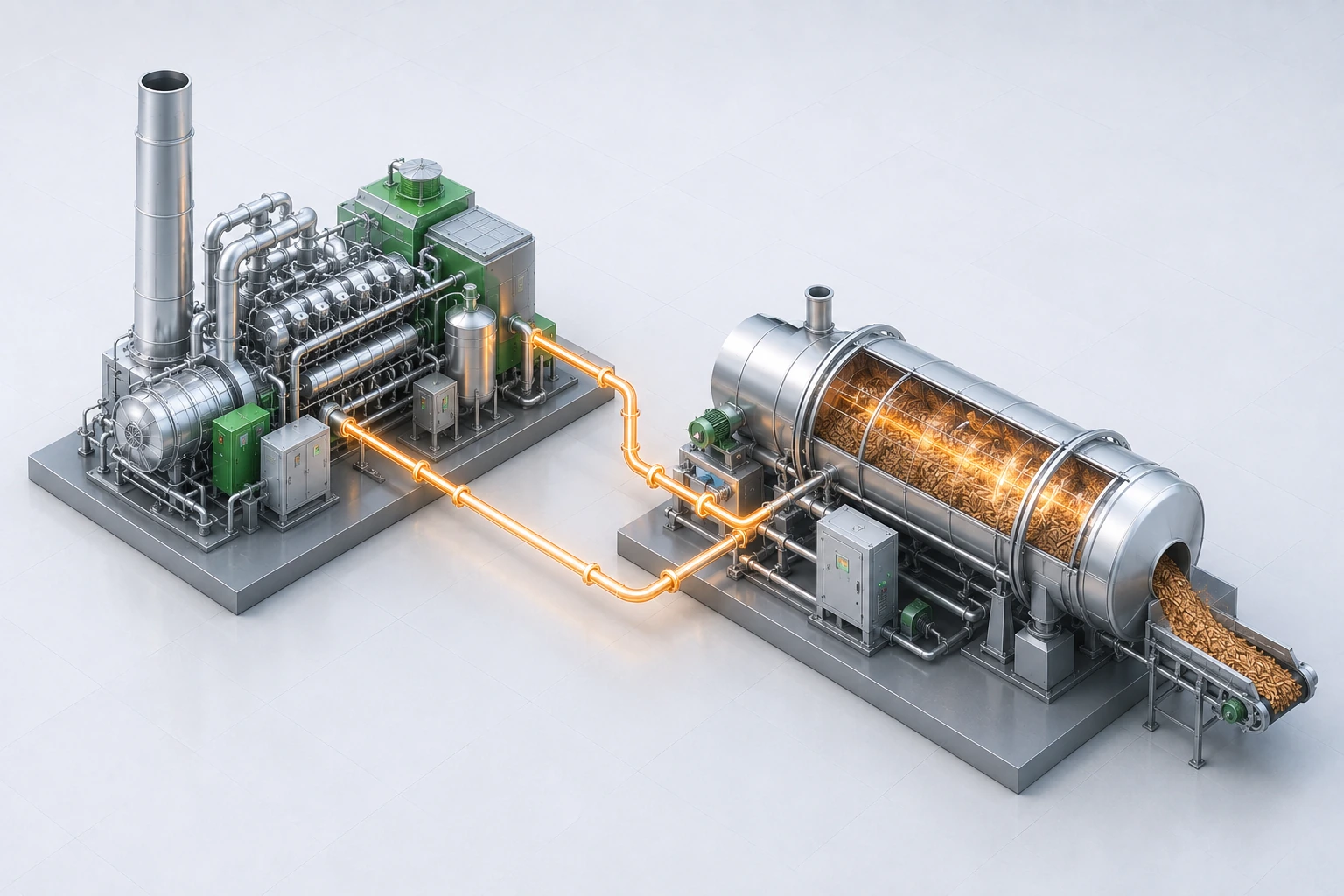
Drying removes water from a product and requires substantial heat. If a biogas plant has hot water available from CHP, some energy that would otherwise be rejected through a cooler can instead heat the drying air.
What can be dried?
Maize and other grains are common agricultural examples, but the same principle applies to wood chips, sawdust, certain biomass streams and many other bulk products. The dryer must suit the particle size, initial and target moisture contents, permitted product temperature and required throughput.
Different products need different dryers
Belt dryers suit continuous, gentler drying at lower temperatures. Conventional agricultural continuous-flow or batch dryers are designed for grain. Rotary or agitated dryers are used where the material must be turned constantly for good contact with warm air. Selection should consider the entire material flow from intake to storage, rather than the equipment price alone.
Why use CHP heat?
Hot water from the engine circuit can heat process air through an air heat exchanger without burning additional fuel in the dryer. Other arrangements are possible if higher-temperature heat is available. The design must check deliverable heat during the coldest and warmest periods and how the dryer responds when CHP output changes.
Seasonality can help or hinder
Grain drying is concentrated in part of the year, so a dryer alone may not use surplus heat in all 12 months. A multi-purpose dryer could handle grain in season and wood chips or other material for the remainder of the year. Contract drying for nearby producers is another possibility.
Manufacturer examples
- STELA Laxhuber – agricultural and belt dryers; the manufacturer explicitly lists waste heat from biogas and CHP plants as a heat source.
- Dorset Green Machines – belt dryers for biomass, wood, digestate and other organic streams using residual heat.
- RHS RHINO – an agitated dryer for various wet materials where waste heat is available.
Air, dust and fire safety must be considered
A dryer project involves more than a heat exchanger and fan. Exhaust-air filtration and possibly scrubbing, dust, noise, fire protection, dry-product storage and conveyor logistics all need to be addressed. Switching products also calls for checks on cleaning and cross-contamination.
Sources and further reading
- STELA – Agriculture drying solutions
- STELA – BTL Agricultural and biogas waste heat
- Dorset Green Machines – Dryers
- RHS Tech – RHINO
This article is for information. An actual installation requires a heat balance, equipment manufacturer data and checks of local conditions, permits and applicable regulations. The illustration shows a functional concept, not a detailed engineering design.