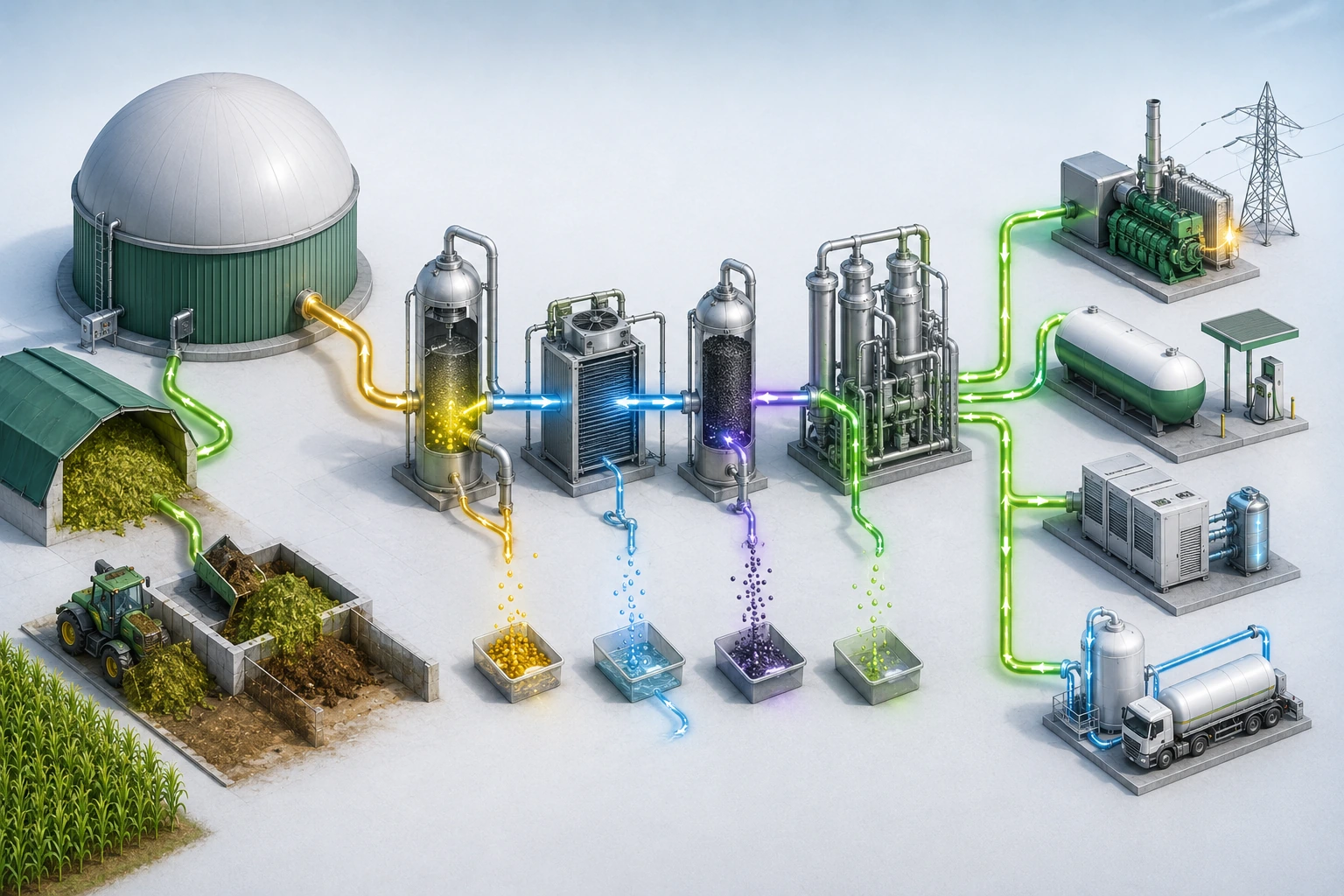
Raw biogas from an anaerobic digester has energy value, but its composition is complex. Alongside methane and carbon dioxide, it contains water vapour and hydrogen sulphide and, depending on the feedstock, particles, ammonia, siloxanes, terpenes and other volatile organic compounds. The starting point for a treatment design is therefore the raw gas composition and end-use requirements, rather than the selection of a single filter.
Cleaning is distinct from upgrading
In practice, it helps to distinguish cleaning from upgrading. Cleaning removes contaminants that cause corrosion, deposits, condensate or catalyst poisoning. Upgrading also separates CO₂ and increases the methane concentration to produce biomethane. In its guidance, the EPA lists cooling or adsorption drying for moisture; adsorption and biological or chemical scrubbing for H₂S; adsorption for siloxanes; and PSA, membranes and chemical absorption among CO₂ removal methods.
Moisture is the first challenge
Gas leaving the digester is almost saturated with water vapour. As the pipeline cools, water condenses. Condensate can create liquid blockages, accelerate corrosion and reduce the effectiveness of activated carbon. Correct pipe gradients, condensate drains, a gas cooler and a water separator are therefore often the first elements of a properly designed gas line.
Address H₂S as early as possible
Hydrogen sulphide is corrosive and toxic, and affects almost all downstream equipment. Its concentration can be reduced during digestion by microaeration or iron-salt dosing, then with an external biological or chemical scrubber, and finally by adsorption on activated carbon or another medium. The right combination depends on the sulphur load and target outlet concentration.
Trace compounds that matter for sensitive equipment
Siloxanes are particularly associated with biogas from sewage sludge and municipal waste streams; combustion can turn them into hard mineral deposits. VOCs, terpenes and other trace compounds can affect engines, membranes, catalysts and adsorbents. Fuel cells and catalytic processes may have very low tolerance for sulphur compounds, requiring an additional polishing stage.
How clean must the gas be?
- CHP unit or boiler: generally require reliable condensate and H₂S removal and, where relevant, removal of siloxanes and other trace compounds.
- Biomethane for the grid or CNG: require pretreatment followed by removal of most CO₂ and compliance with the local gas specification.
- Fuel cells: may require very deep removal of sulphur compounds and siloxanes, depending on the cell technology.
- Bio-LNG: need further polishing after upgrading, with very deep removal of CO₂ and water before liquefaction.
Manufacturers and solutions
Bright Renewables combines moisture removal and activated carbon with membrane upgrading. Greenlane Renewables offers water wash, PSA and membranes alongside desulphurisation. Air Liquide uses membrane systems and raw biogas pretreatment. Manufacturers such as Paques, Biogasclean, CarboTech, Jacobi and DESOTEC.
Sources and further reading
- U.S. EPA – AgSTAR Operator Guidebook
- Bright Renewables – Biogas upgrading: gas treatment
- Greenlane Renewables – Biogas upgrading technologies
- Air Liquide – Biogas purification technologies
This article is for information only. The final cleaning specification must be based on analysis of the actual gas composition, the end user's requirements, safety rules and confirmation from equipment manufacturers. The illustration shows the functional principle, not a construction design.