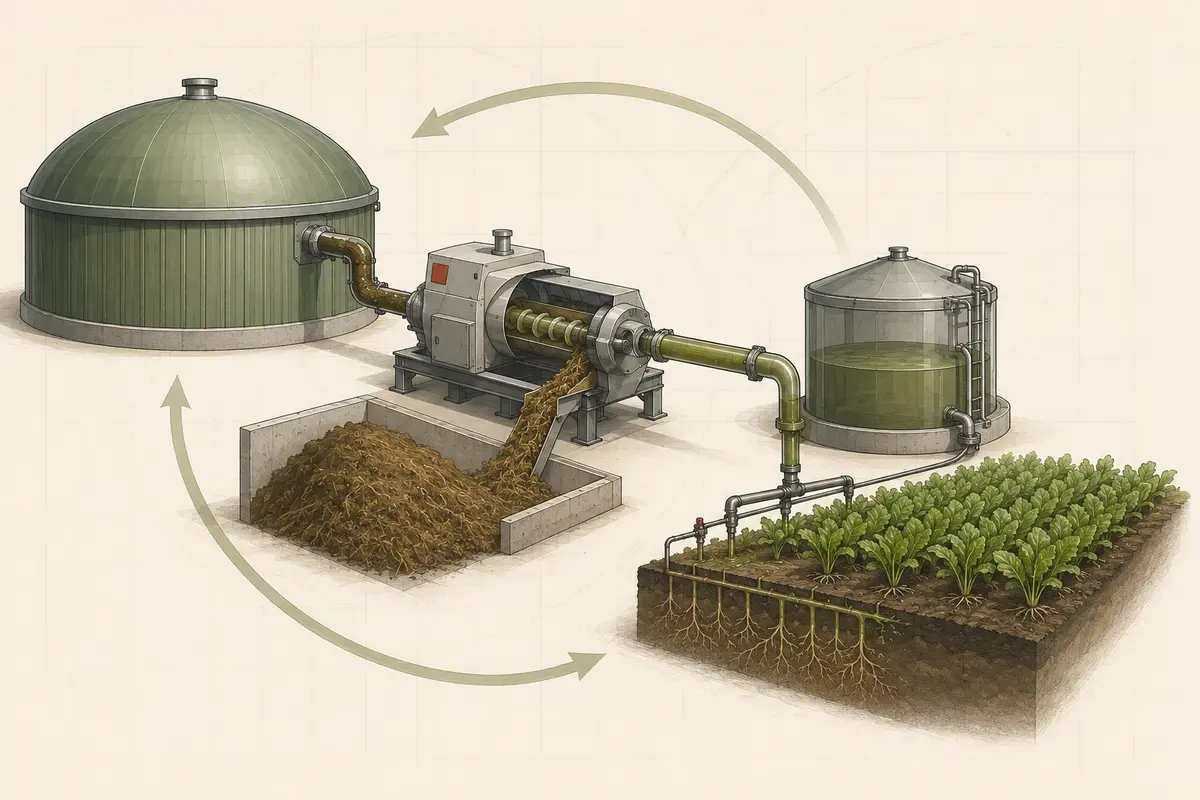
After microorganisms produce biogas from organic matter, digestate remains in the digester. It is not a valueless residue: it contains organic matter and plant nutrients that can be useful in agriculture. Its use must, however, be planned around soil quality, crop needs and applicable rules.
What changes during digestion?
Some organic carbon is converted into biogas, while most mineral nutrients remain in the digestate. Nitrogen is often present in a form more available to plants than in the original feedstock. This can be an advantage, but also increases the risk of ammonia losses if digestate is not stored and applied properly.
Solid and liquid fractions
Digestate can be separated mechanically. The solid fraction has a higher dry matter content and may be easier to transport, compost or process further. The liquid fraction retains much of the soluble nutrients and requires adequate storage capacity and accurate field application.
Separation does not remove nutrients from the system; it distributes them between two fractions. Before investing in equipment, the destination of each fraction, handling costs and its actual value to the user must be defined.
Quality starts with the inputs
Contaminants and unwanted substances in the input feedstocks do not simply disappear during digestion. Input controls, hygiene requirements, laboratory analyses and traceability are essential for safe use. A nutrient application plan must account for available quantities, field distances, application periods and storage capacity.
Sources and further reading
- T. Al Seadi et al., Priručnik za bioplin, BiG>East, 2008.
- U.S. EPA – How Does Anaerobic Digestion Work?
This article is for information only. It does not replace design work, a professional assessment, or legal, environmental or financial advice for a specific project.