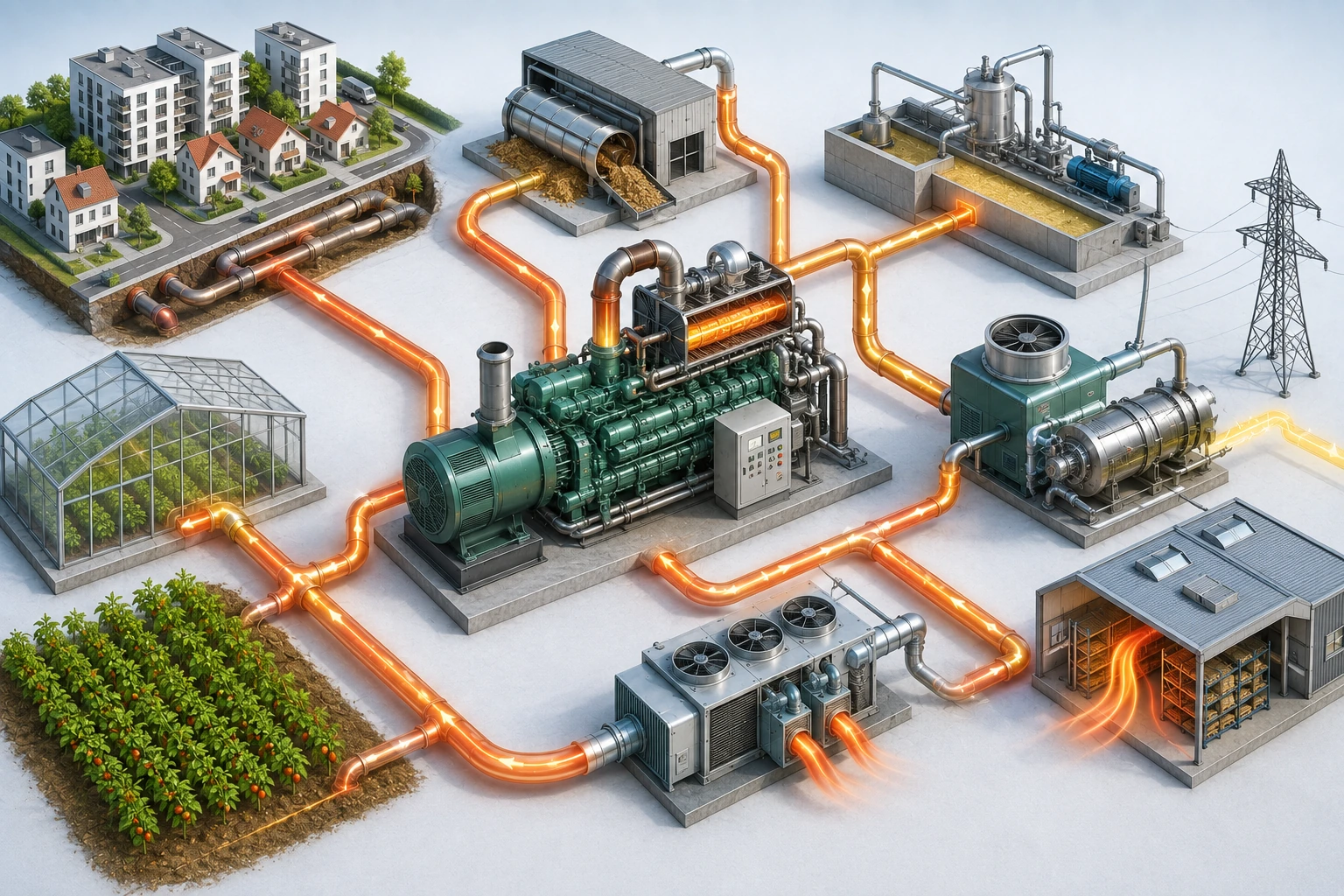
At most biogas plants, some heat already has a defined use: maintaining digester temperature, heating plant rooms, producing hot water or sanitising certain material streams. The challenge arises when the CHP unit continues running after these needs are met and surplus heat is rejected through a cooler.
Two principal sources: engine and exhaust
The first source is the engine cooling circuit: a steady hot-water stream suitable for heating digesters, buildings and greenhouses, supplying heat networks and lower-temperature dryers, or providing a source for a heat pump. The second is the exhaust gas. Its higher-temperature heat can be recovered through a heat exchanger for hot water, steam, thermal oil or a system such as ORC. Actual temperatures, flow rates and available capacity depend on the engine and heat-recovery design.
Meet the plant's own heat demand first
Heat used on site often has the lowest delivery cost. Heating the digester, sanitisation, warming a workshop or administration building and preparing process water require neither a long heat network nor an external buyer. Only after accounting for these uses does it make sense to calculate the actual annual heat surplus.
How can surplus heat be used?
- deliver heat to a settlement, farm or public buildings through a heat network
- dry grain, wood, biomass and other products
- dry separated digestate for further processing
- produce pellets or granules from dried digestate
- supply nearby industry with hot water or process heat
- use a heat pump to raise the temperature for a higher-temperature process
- produce chilled water with an absorption chiller
- convert some heat to additional electricity with an ORC system
Cascading heat use can be better than one large user
A high-temperature source need not be used solely for a demand requiring lukewarm water. In a well-designed cascade, heat first serves higher-temperature needs, then the return flow serves lower-temperature heating, drying or a greenhouse. The same recovered heat can thus provide more than one useful service.
What should be measured before deciding?
Before selecting a technology, prepare an annual heat balance: how much remains after the plant's own needs, at what temperature and for how many hours; how far away is the user; and what happens when the CHP unit stops? Investment, auxiliary electricity consumption, maintenance and revenue from the final product can then be compared.
Sources and further reading
This article is for information. An actual installation requires a heat balance, equipment manufacturer data and checks of local conditions, permits and applicable regulations. The illustration shows a functional concept, not a detailed engineering design.